


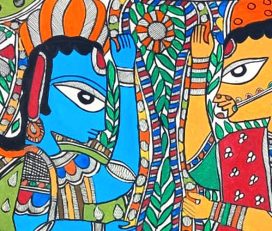
Madhubani/Mithila Pa...
Mithila painting, is a vibrant and deeply symbolic folk art tradition originating from the Mithila region of Bihar, India, and adjoining parts of Nepal.
Madhubani, Bihar, India...
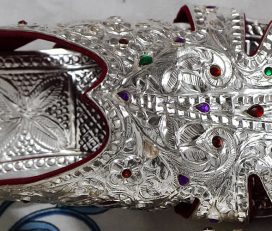
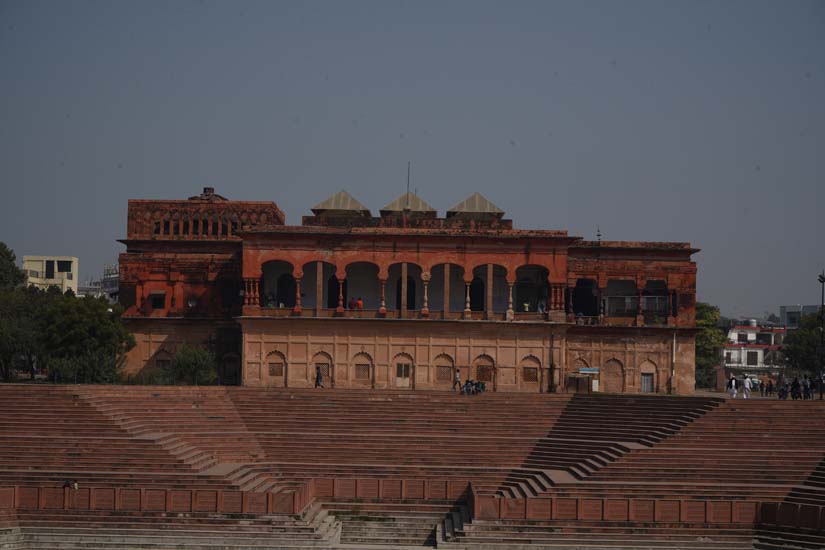
 Bara Imambara, Husainabad, Luc...
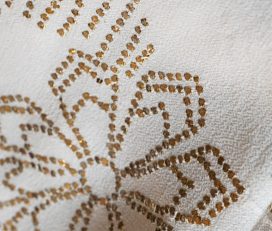 Lucknow, Uttar Pradesh, India...
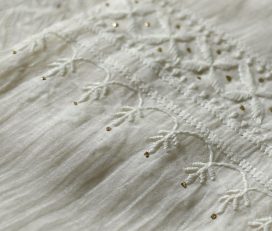 Lucknow, Uttar Pradesh, India...
 Chitrakoot, Uttar Pradesh, Ind...
Mithila painting, is a vibrant and deeply symbolic folk art tradition originating from the Mithila region of Bihar, India, and adjoining parts of Nepal.
Madhubani, Bihar, India...
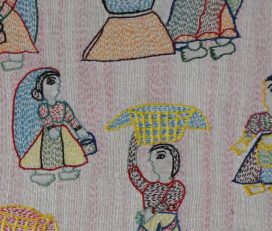
Sujani is a distinctive embroidery tradition of Bihar, particularly practised in Muzaffarpur district and surrounding villages.
Bhusra, Bihar, India...

Arani silk, also known as Arni silk, is a celebrated handloom tradition of Tamil Nadu, produced primarily in Arani, Tiruvannamalai.
Arani, Tamil Nadu, India...
Let us talk… if you feel the same love for handmade, and would like to support us by sharing your research or by contributing financially to our documentation efforts.
Reach us at [email protected]
The craft of bone carving dates back to prehistoric times, when bones were used for making ornaments & utility articles. Utility was often merged with unique self-expression to create objects like weapons, beads, combs and other unusual artefacts from animal bones.
In earlier times, bone carvings were often made for specific rituals and ceremonies. Intricately carved bone handles, for instance, were used for traditional daggers, ritualistic knives, and sacred objects. These objects were believed to possess protective qualities and were used in rituals and practices, sometimes associated with protection from Evil eye (buri nazar) and were also considered auspicious in tantra-mantra traditions.
Bone was also widely used in traditional Indian jewellery, especially among tribal communities, where it held cultural significance and was worn as ornaments.
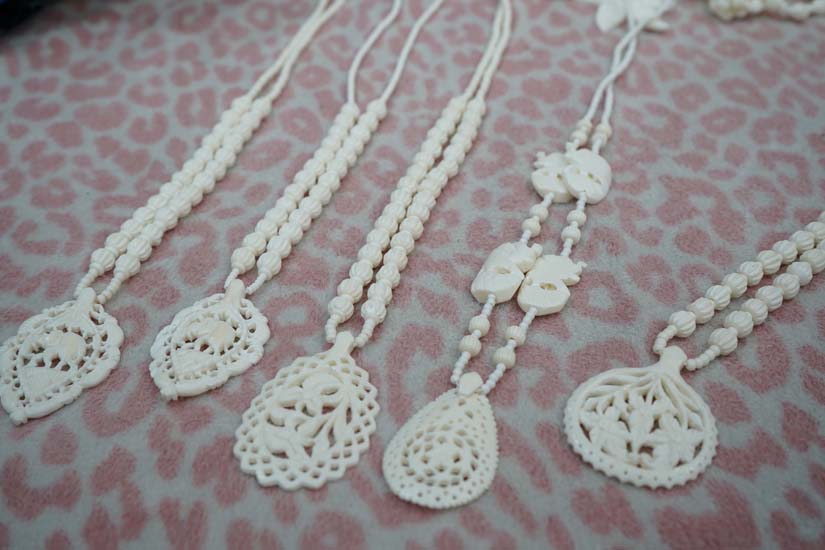
Today, bone carving has evolved into a contemporary craft that blends tradition with modern aesthetics. Intricately carved bone pendants, beads, bangles, and earrings showcase the skill of artisans and have become a hallmark of the craft in current markets. A wide range of products are now available, including necklaces, cufflinks, rings, bracelets, boxes, pen stands, bookmarks, flower vases, perfume bottles, and decorative daggers.
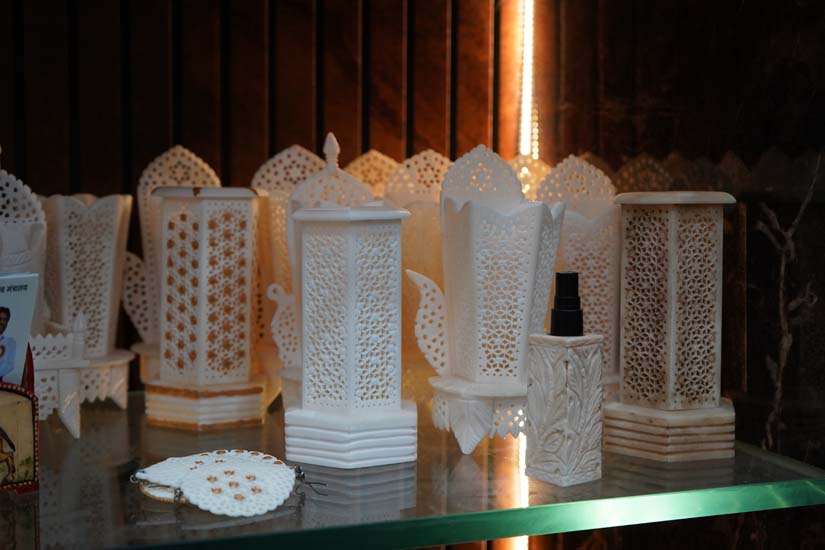
The craft has also expanded into utility and lifestyle products such as stationery items like, pen stands, pens, paperweights, and visiting card holders, as well as home décor pieces like clocks, lamps, boxes, and showpieces. These products are often used for corporate gifting and personal gifting purposes.
Due to the delicate nature of bone, the carved products require careful handling, as they can break if dropped.
Today, the primary demand comes from urban markets such as Hyderabad, Bangalore, Kolkata, and Mumbai, with many products also being exported. Among all items, lamps are the most popular, followed by perfume bottles and agarbatti stands. The price of these handcrafted pieces typically ranges from ₹100 to ₹50,000, depending on the intricacy and scale of the object.
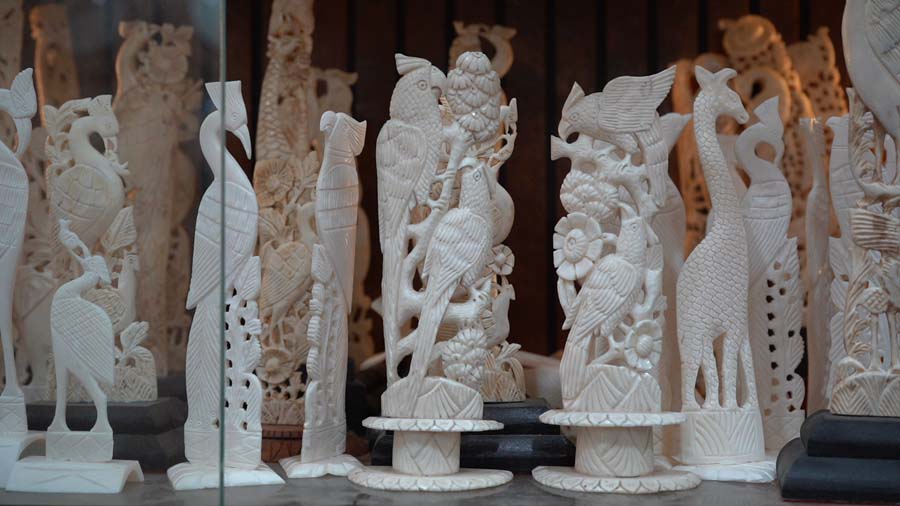
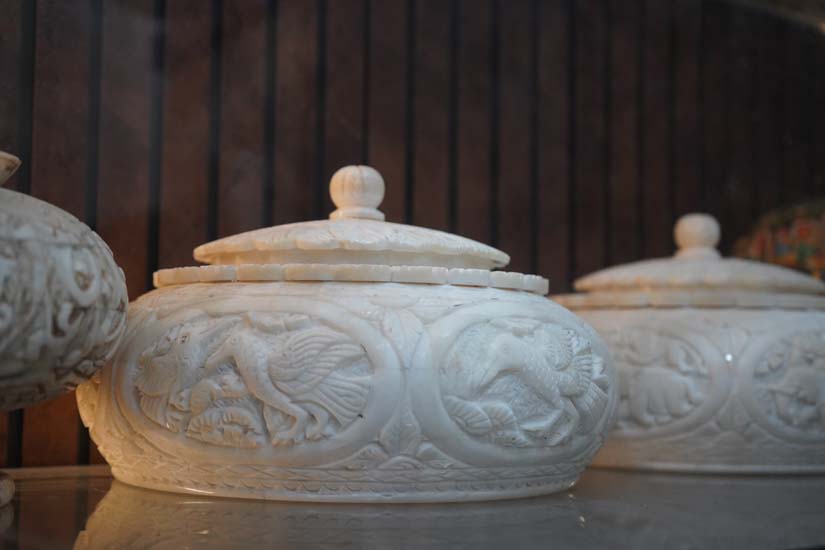
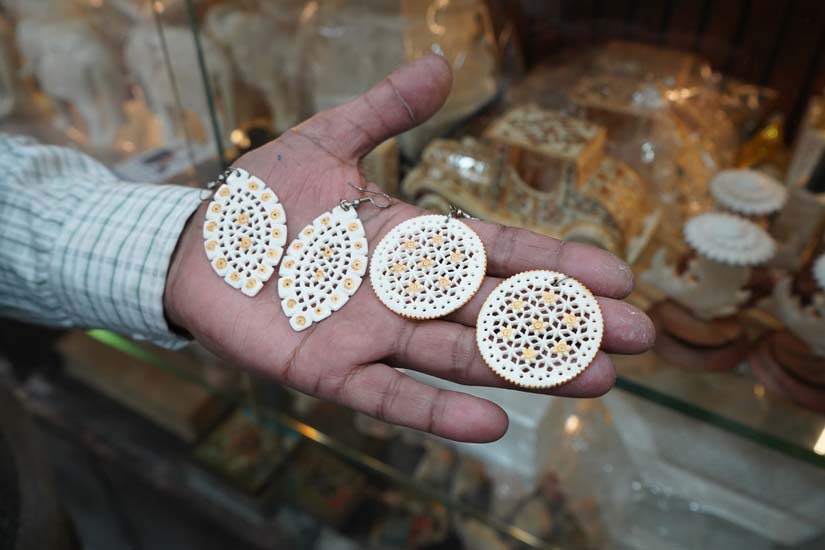
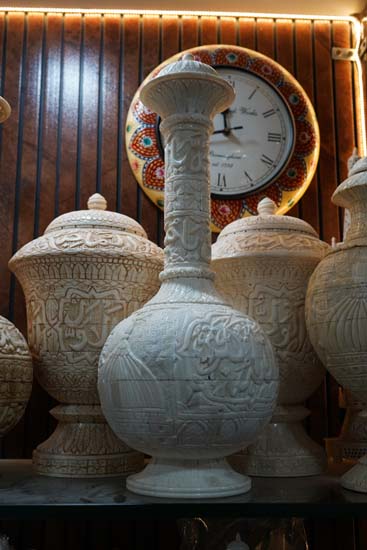
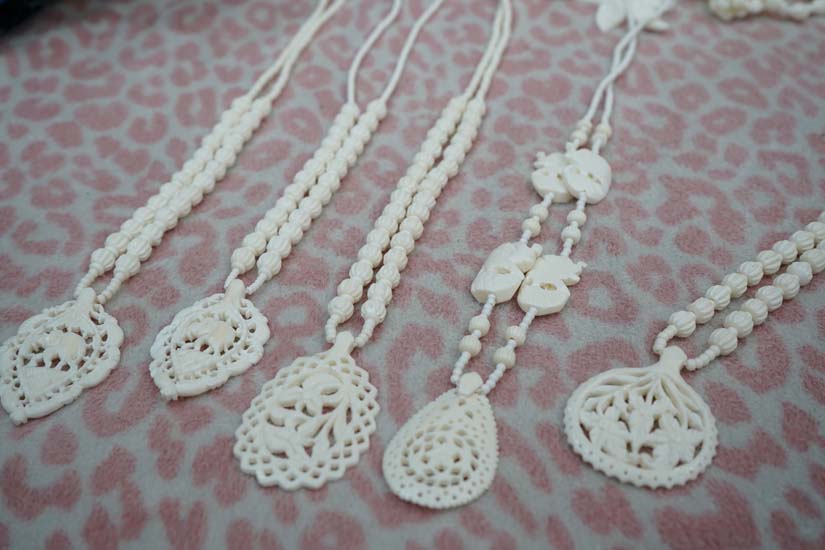
The significance of bone carving lies in the transformation of material. Bone is a widely available resource, largely sourced from naturally deceased animals and slaughterhouses. In its original form, however, bone is not readily accepted by most people. Unlike materials such as ivory or animal teeth, which have historically been valued and admired, raw bone carries a very different perception.
Across many tribal communities in India, teeth, bones, and nails of animals have traditionally been used to create ornaments. Yet, materials like buffalo bone have rarely received similar acceptance. It is through the skill and dedication of artisans that this raw material is transformed into refined, luxurious products, often making it difficult to imagine its original form. Importantly, these crafts also offer a sustainable alternative to ivory, helping reduce dependence on materials that require strict conservation, while making meaningful use of an otherwise discarded resource.
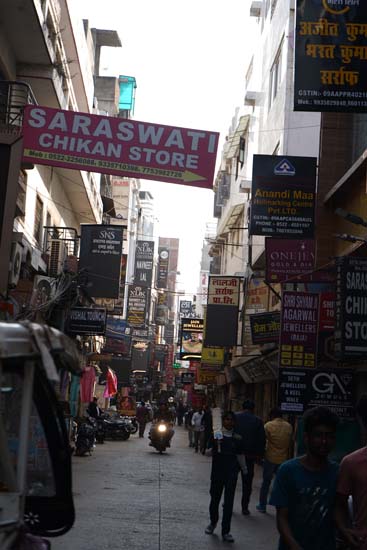
Bone carving is a traditional craft practiced across several regions in India, including Kolkata, Delhi, Sambhal, Jaipur, Jodhpur, Lucknow, and Barabanki. In the Maliaraiganj area of Barabanki alone, there are around 200 karkhanas (workshops) engaged in this craft, and overall, nearly 1,000 artisans are estimated to practice bone carving. In Uttar Pradesh, the craft is concentrated in areas such as Daulatganj, Khadra, and Campbell Road in Lucknow, where approximately 200 to 300 artisans continue the tradition. The craft is predominantly practiced by the Muslim community, with only a few Hindu artisans involved.
Beyond India, bone carving traditions are also found in regions such as Ukraine and Bali, where artisans create intricate works with distinct visual styles that differ from Indian traditions.
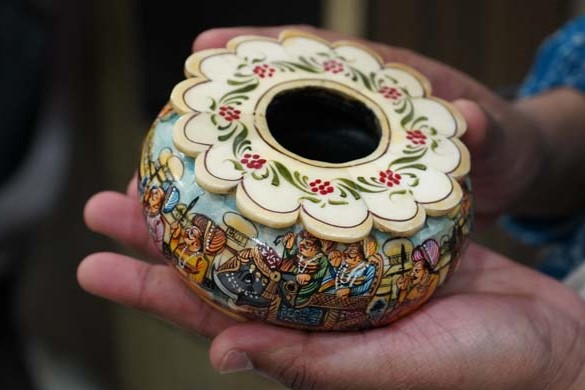
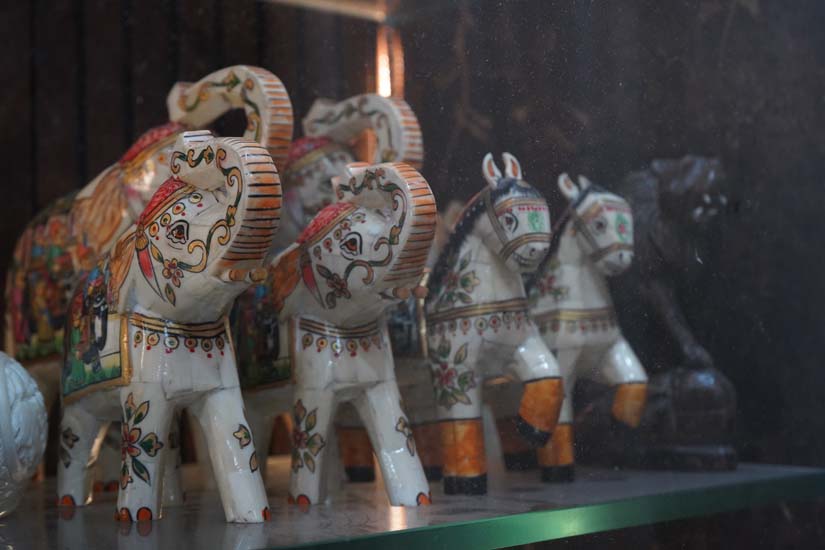
Within India, each region has developed its own unique approach. In Jodhpur, artisans are known for carving and painting containers and lamp bases, often using camel bone. Jaipur is recognised for detailed, narrative-style painting on carved bone objects. Sambhal, which has received a Geographical Indication (GI) tag, is especially known for bone inlay work used in furniture, photo frames, and trays. Kolkata is associated with sculptural bone carvings, while Lucknow is renowned for its delicate jaali and naqqashi work.
Historically, bone carving in India was influenced by Persian aesthetics during the Mughal period. Intricate motifs, calligraphy, and jaali patterns reflect this influence, making the craft not only decorative but also symbolic, often associated with wealth, piety, and power among the Mughal nobility.
The revival of bone carving in Lucknow has been supported by both government and private initiatives. Through public-private partnerships, artisans are given opportunities to conduct workshops and train younger generations, often supported by stipends and structured programs. Institutions such as the Uttar Pradesh Vigyan Manch, Mahila Kalyan Nigam, and Kamla Nehru Seva Sadan have played a significant role in promoting awareness and supporting craft-based livelihoods. These efforts have helped restore both economic stability and cultural pride among artisan communities.
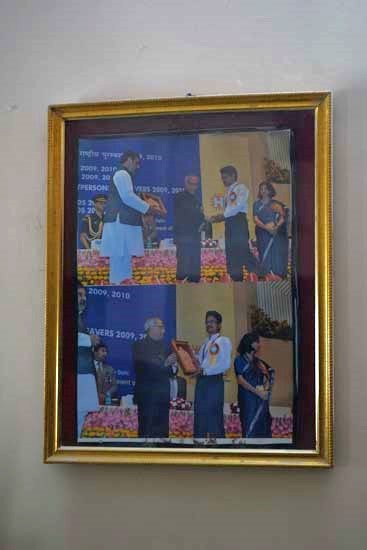
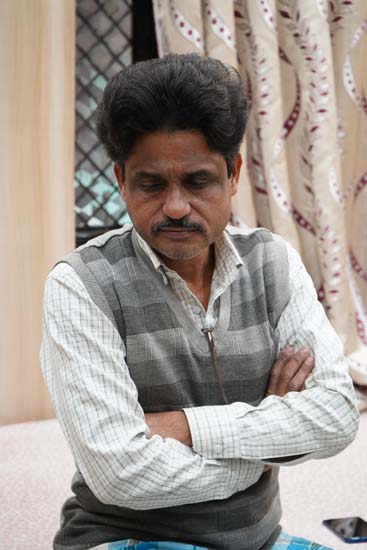
Recognition through awards, including National and State Awards, has brought visibility to the craft and its practitioners. For instance, Jalauddin Akhtar ji from Lucknow received the State Award in 2002 and the National Award in 2009, bringing wider recognition to this tradition. Ho
no stories
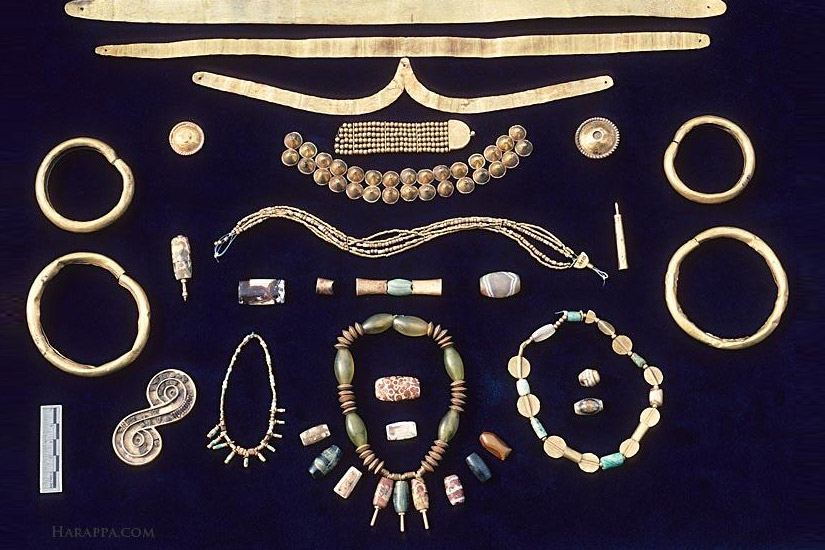
The origins of bone carving in India can be traced back much further. Archaeological evidence from the Indus Valley Civilisation, particularly from sites like Mohenjo-daro and Harappa, reveals carved bone objects such as beads and pins. These were primarily utilitarian in nature, indicating an early familiarity with the material.
The craft of Bone carving practised in Lucknow is a century-old, intricate craft that was historically supported by Nawabi patronage. It is believed to be around 700–800 years old.
The craft flourished during the Mughal period, especially under emperors like Jahangir and Shah Jahan, when artistic practices such as inlay work, miniature painting, and jaali carving reached remarkable levels of refinement. During this time, artisans began substituting ivory with camel and buffalo bone, adapting to changing material availability while preserving the finesse of Mughal aesthetics. Resulting in an overall decline of this craft of bone carving for a few years.
Under the Nawabs of Awadh, Lucknow emerged as a major centre of craftsmanship. Bone carving became an integral part of the city’s artistic identity, reflecting the ornamental language seen in monuments like Bara Imambara and Rumi Darwaza. The Nawabs patronised artisans by providing financial support and social prestige, enabling the craft to thrive.
Lucknow was also historically an important centre for ivory carving; however, following the global ban on ivory trade in 1989, artisans transitioned to carving camel and buffalo bone. This shift positioned bone carving as a more sustainable and ethical alternative, as it relies on waste material.
Traditionally, camel bones were used as the primary material; however, in present times, buffalo bones are more commonly used. These bones are sourced from slaughterhouses, utilising waste material from the meat industry that would otherwise be discarded.
Earlier, artisans primarily created items such as boxes, daggers, vases, necklaces, and miniature models like the Taj Mahal. However, over time, the range of products has evolved. A significant shift occurred around 2016–17, when the National Institute of Fashion Technology (NIFT) invited the artisan from Lucknow for collaborative workshops at its Raebareli campus. These workshops introduced new design approaches, tools, and market strategies, leading to the development of contemporary products such as cufflinks, brooches, and other small-scale accessories.
Typically, bone carving has been practised predominantly by Muslim artisan communities. However, in recent years, some Hindu artisans have also begun to learn the craft and produce smaller items, indicating a gradual expansion of the artisan base.
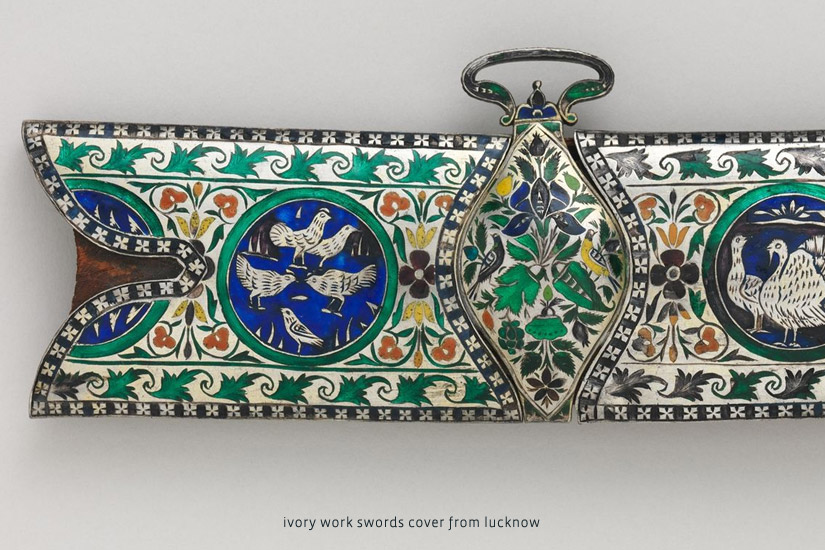
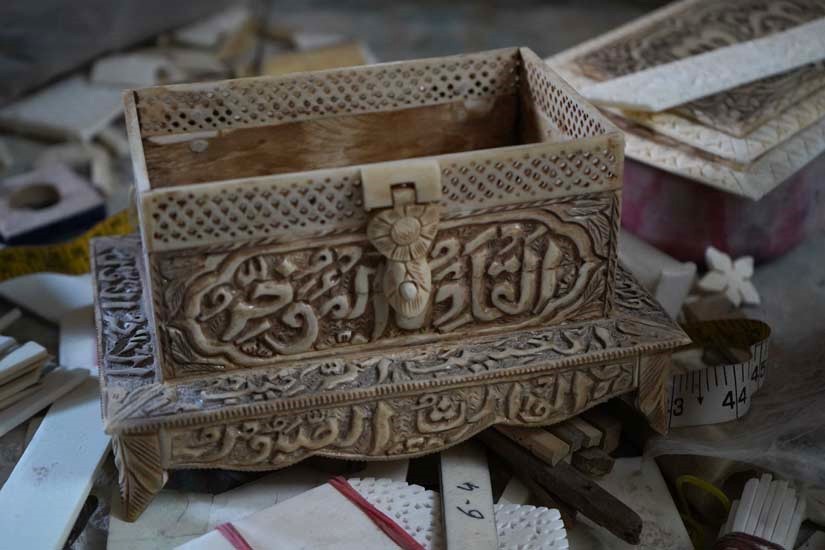
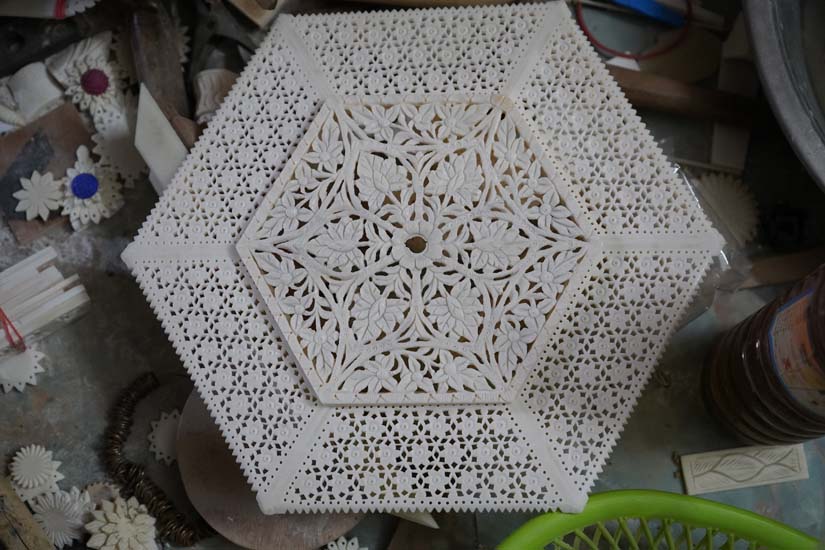
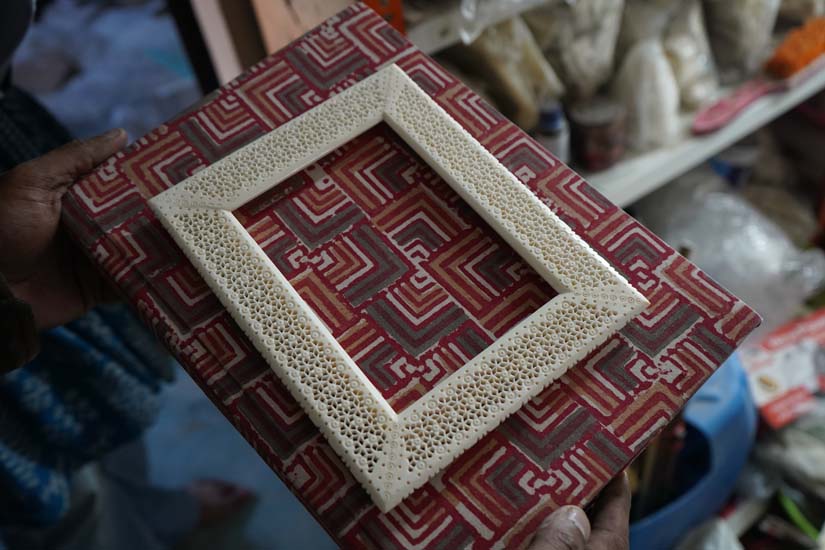
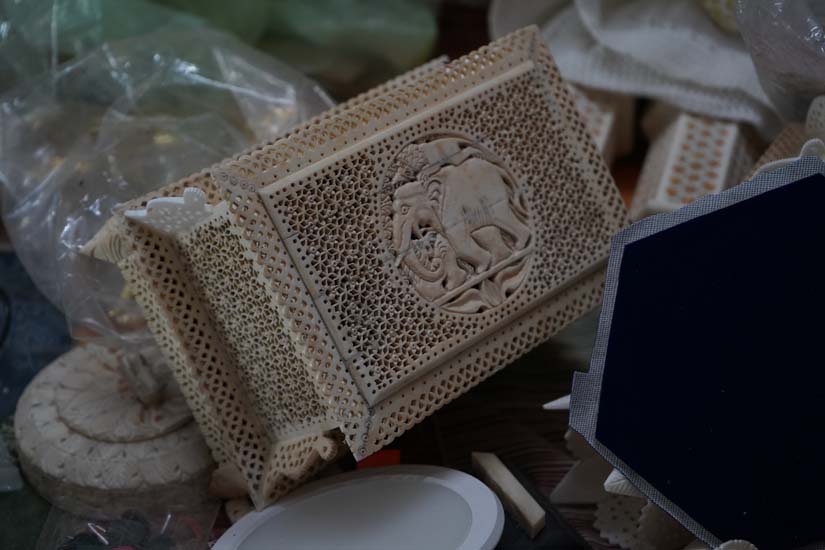
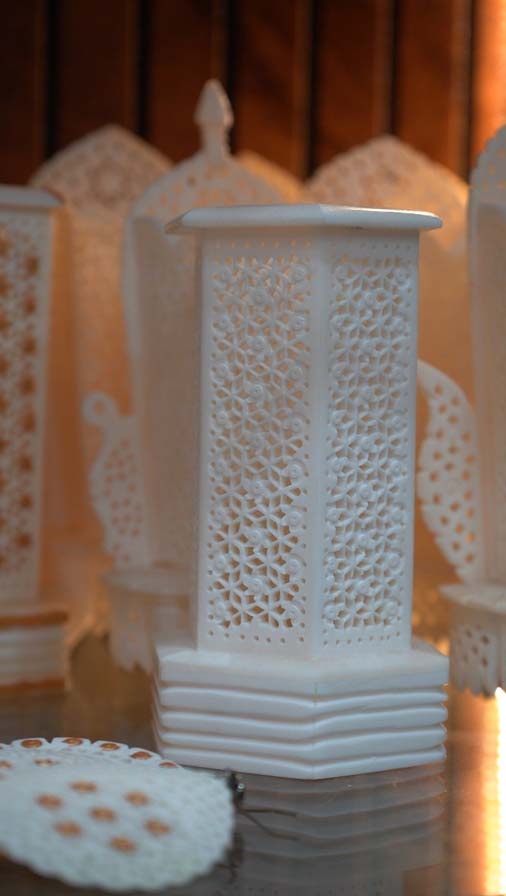
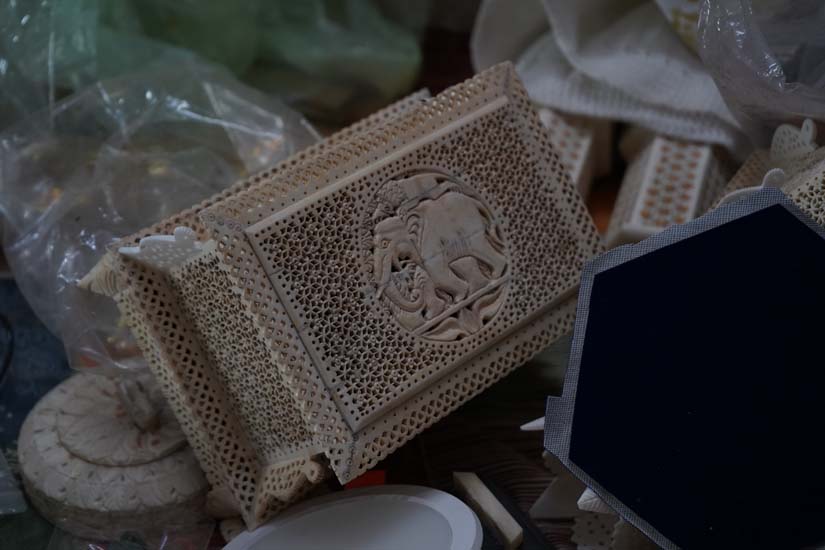
The main visual elements in bone carving include motifs of animals, birds, peacocks, flowers, and Urdu calligraphy. The craft of Bone carving from Lucknow is particularly known for its delicate phool-wali jaali (floral lattice work) and Arabic calligraphy. These jaali designs are extremely intricate and draw direct inspiration from the architectural language of Lucknow, especially the lattice screens seen in monuments like the Bara Imambara.
Floral patterns such as bel-patti are commonly used across a variety of products, including boxes, jewellery, lamps, and other decorative objects. Most motifs are inspired by nature and Awadhi architecture, and artisans typically create original designs rather than copying existing ones.
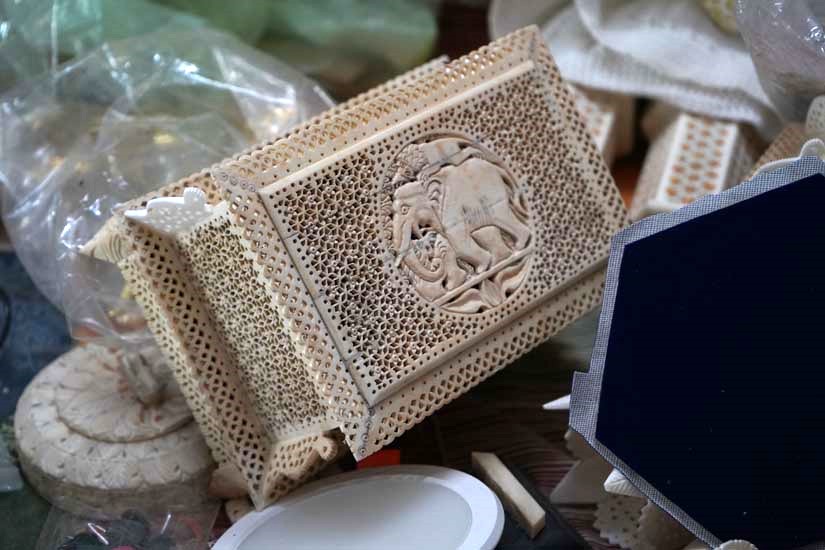
Broadly, the work in Lucknow can be categorised into two types. The first is jaali or lattice work, a defining feature of Mughal architecture, which is extensively used in jewellery boxes, lamps, and other hollow objects. The second is carving designs which is done on thicker pieces of bone and often depicts detailed hunting or forest scenes featuring elephants, tigers, parrots, peacocks, and flowering trees.
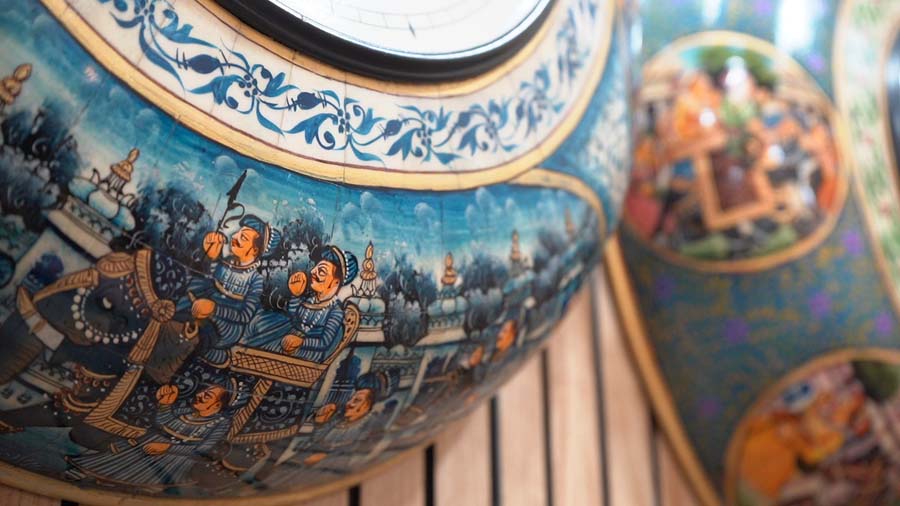
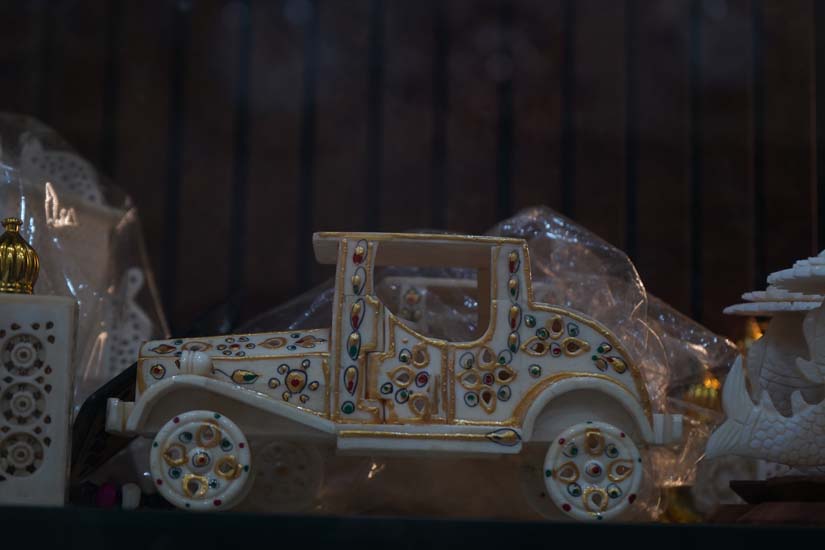
The range of products is extensive, including lamps, paper knives, pen stands, pens, juda (hairbun) sticks, bookmarks, combs, buttons, earrings, necklaces, clocks, vases, rings, pendants, and decorative items such as the ambari elephant. Some products, such as clocks and flower vases, also incorporate painting. In such cases, small square pieces of bone are cut and meticulously assembled onto a wooden base, after which they are sent to Rajasthan for painting. A single flower vase of about two feet in height may consist of 600–700 small bone pieces assembled together.
The size of the products varies widely, from small jewellery items like earrings to large customised pieces such as lamps up to 50 inches in height. Over time, bone naturally changes colour, developing a warm yellowish-brown colour. Older pieces are often considered more valuable due to this ageing effect. In some contemporary products, artisans also apply finishes to create an oxidised appearance of an older piece.
The Awadhi style of bone carving is deeply influenced by the region’s architectural heritage, reflected in its intricate jaali patterns and floral ornamentation. This style is visible in objects such as jewellery boxes, pen holders, decorative pieces, and figurines, echoing the grandeur of landmarks like the Bara Imambara, Chota Imambara, and Rumi Darwaza in Lucknow.
Bone carvings in India encompass a wide range of subjects and symbolism. Drawing from the country’s rich biodiversity, artisans frequently depict flora and fauna such as birds, elephants, peacocks, and lotus flowers, each carrying cultural and spiritual meanings related to beauty, fertility, and protection.
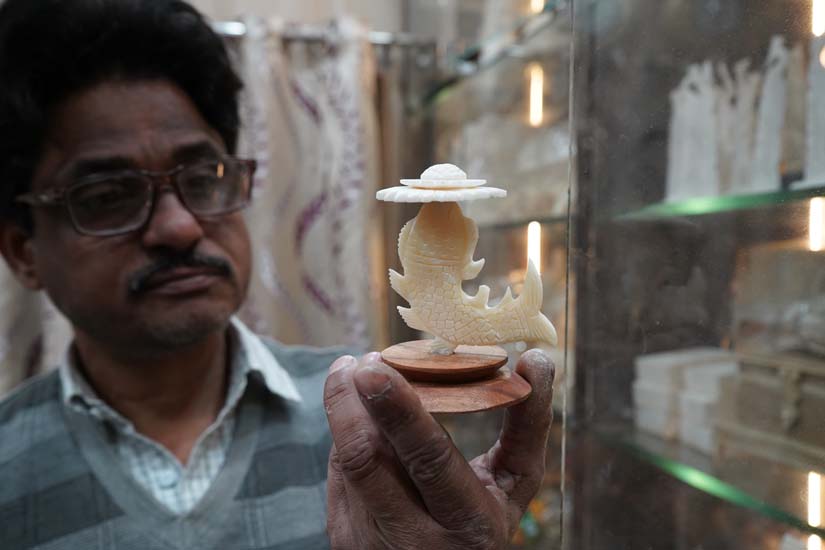
Very few skilled practitioners of this craft remain today. Many artisans are gradually moving away from it and shifting to other professions in search of better livelihoods. The craft demands immense patience and hard work, and at times, the working conditions are not clean or conducive to good health. The younger generation today has access to alternative employment opportunities where income can be earned with comparatively less effort. Without proper preservation and sustained support, the craft risks declining significantly, and may even face extinction within the next 50 years, as shared by artisans themselves.
Despite these challenges, the craft has strong demand in international markets and holds significant potential for growth. With the involvement of creative individuals and renewed interest, it can evolve further. However, inadequate promotion within India continues to limit its reach, and at times, even raw materials becomes a constraint.
The craft of bone carving has a 4 to 5 day process that involves cutting the bone, boiling it in a soda solution to remove fat, carving, bleaching it with hydrogen peroxide, and polishing. Artisans use specialised tools to carve and shape bones into intricate designs. Using small chisels, gouges, files, and drills, the artisan gradually removes excess material to create the intended form and detailed patterns. The complete process requires great precision, patience, and a deep understanding of the craft.
The main raw material is the bones. Artisans use buffalo bones, which are obtained from slaughterhouses. These bones are the waste material left behind after the buffalo meat is exported, which would have otherwise been buried. Different parts of the bone are used for specific purposes based on their shape, thickness, and strength:
Gola – Used for making showpieces
Bhanhu – Suitable for smaller items such as earrings and pendants
Tersoor – The main leg bone; thick and wide, used for a variety of products. It is considered the best quality bone, from which strips up to 1 inch thick can be obtained, costing around ₹60 per piece
Tedhi Nali – Used for pendants
Paaya – Thin bones used for making pens and rings
Hydrogen peroxide – cleans the material further and gives it a uniform, bright appearance.
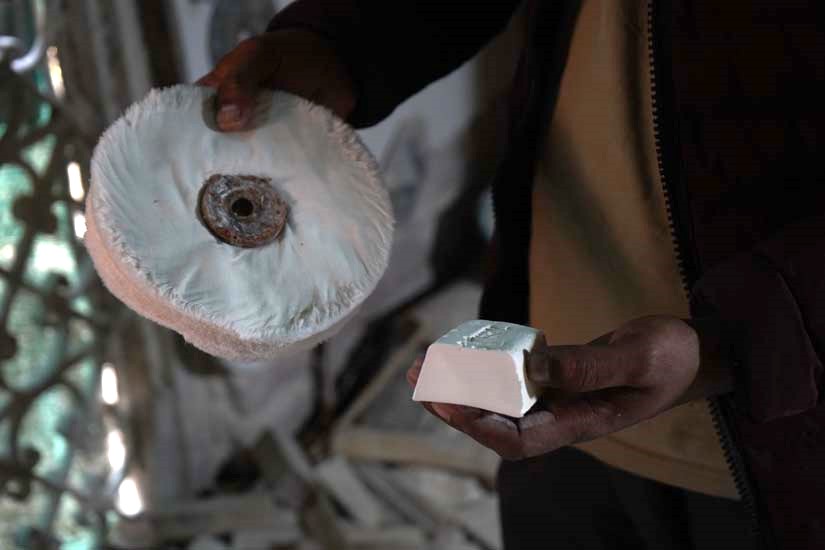
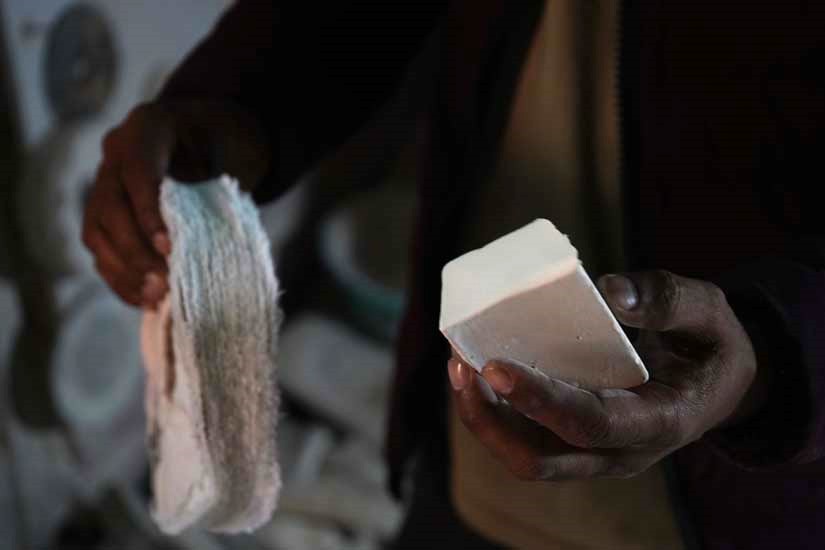
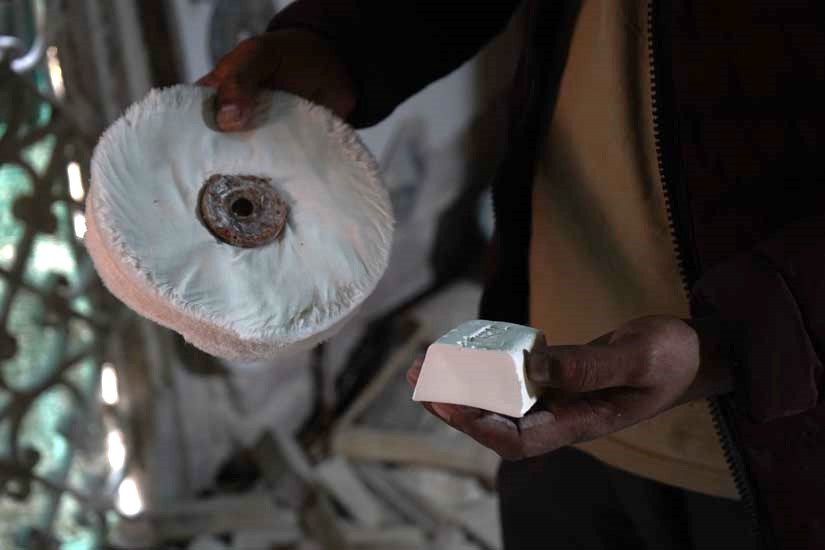
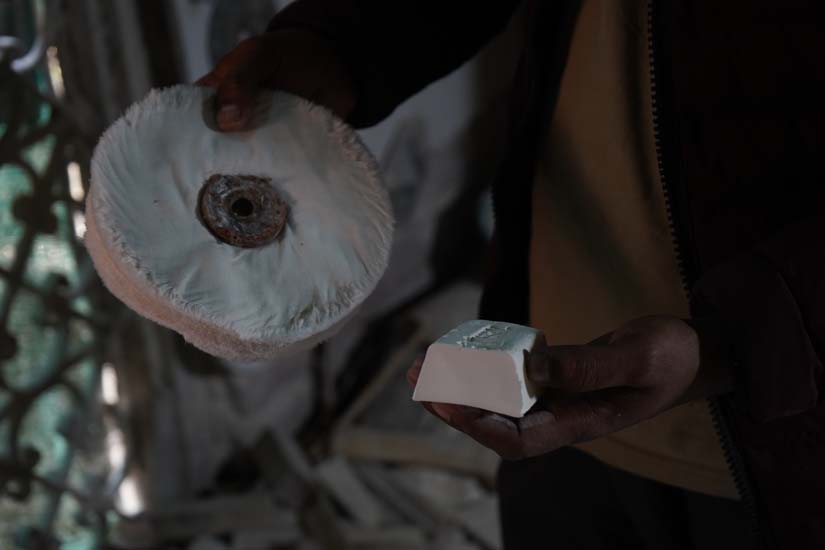
Buffing soap – Remove scratches while leaving a smooth finish
Unfinished bone pieces typically cost around ₹80 per kg, whereas flat, finished, treated, whitened large bones cost around ₹500- ₹800 per kg, the price varies depending on quality and availability.
In addition to bone, artisans use supporting materials such as Fevicol (adhesive) for joining pieces and resham ka dhaga (silk thread) for assembling jewellery like necklaces and bracelets.
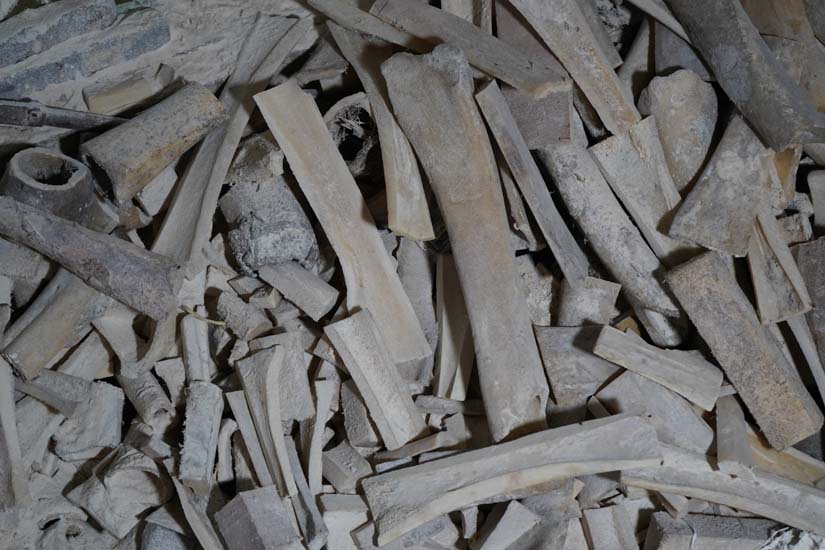
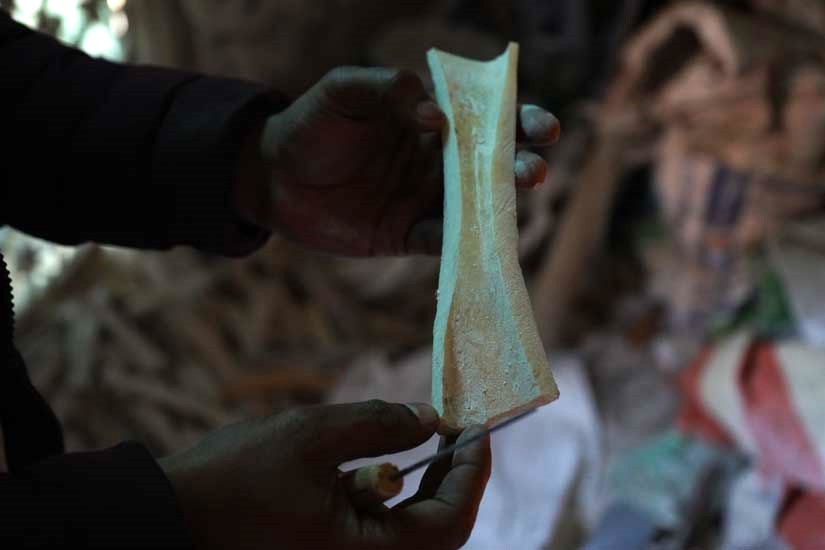
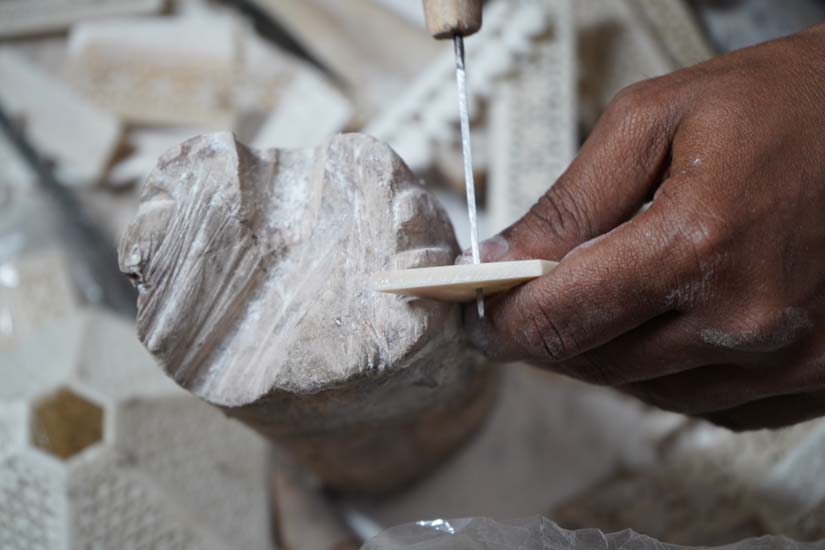
Aari (handsaw) – Traditionally used for cutting bones
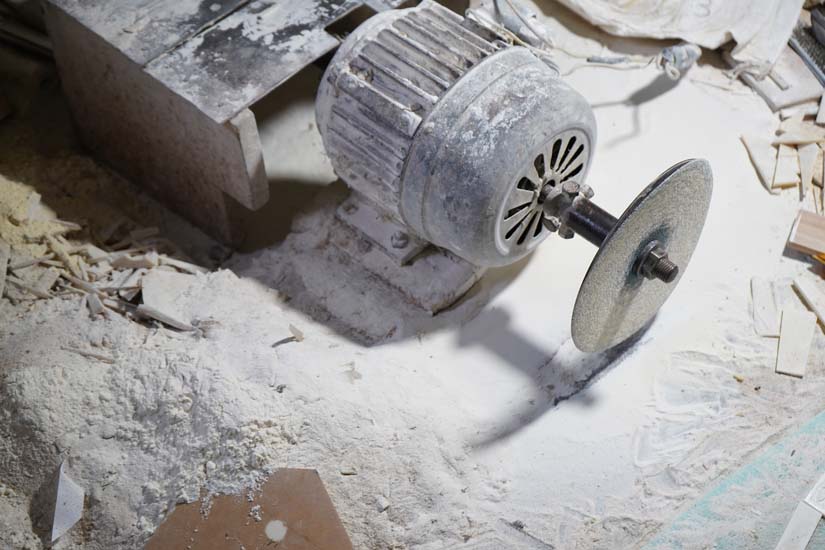
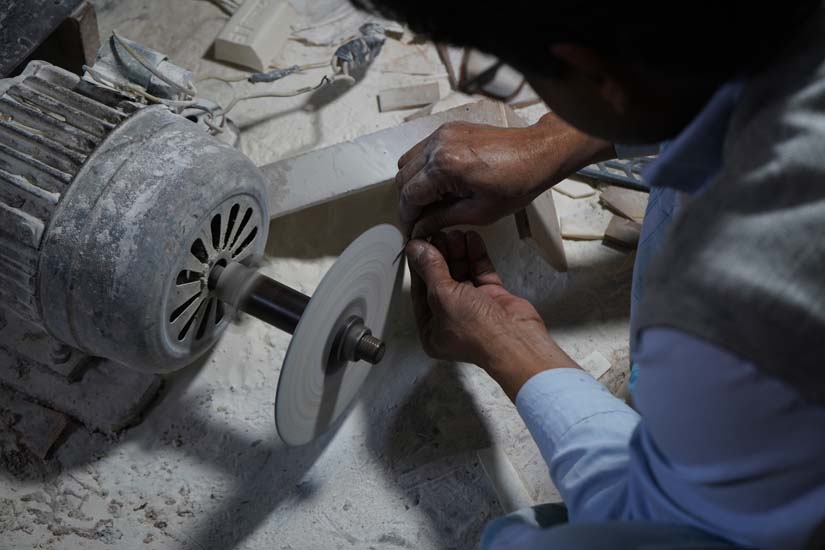
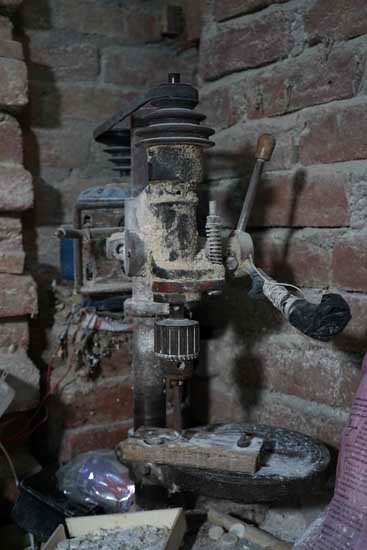
Motor machine – Used to cut bones, smoothen them and also for buffing
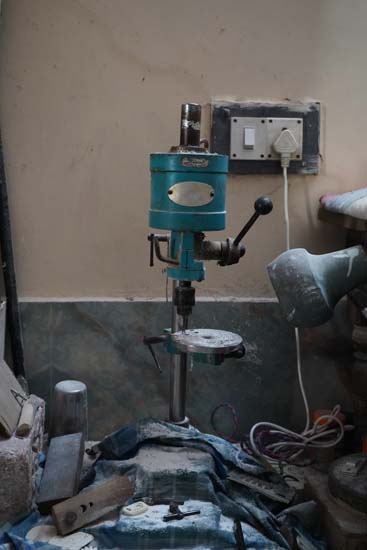
Drilling machine (Barma) – Used to make holes in the bone
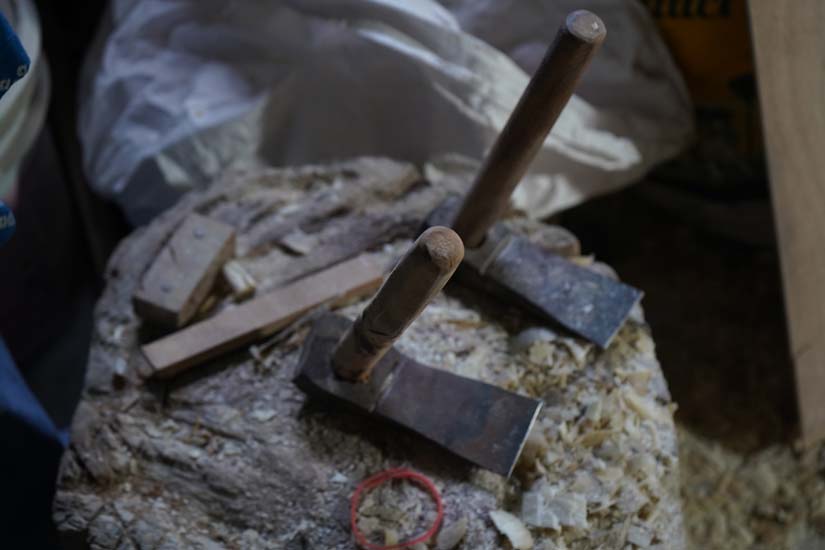
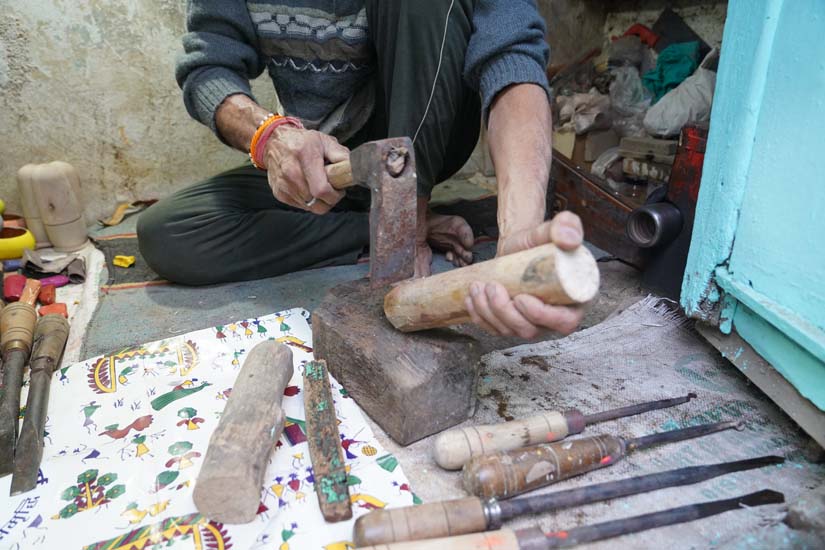
Basul – A hammer-like tool used for peeling off the outer layer of the bone
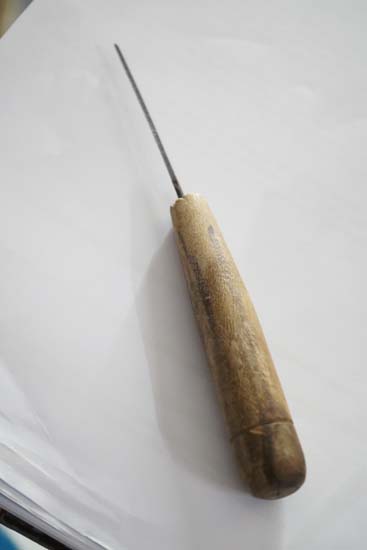
Teherka / Chausi (chisels) – Used for carving and detailing
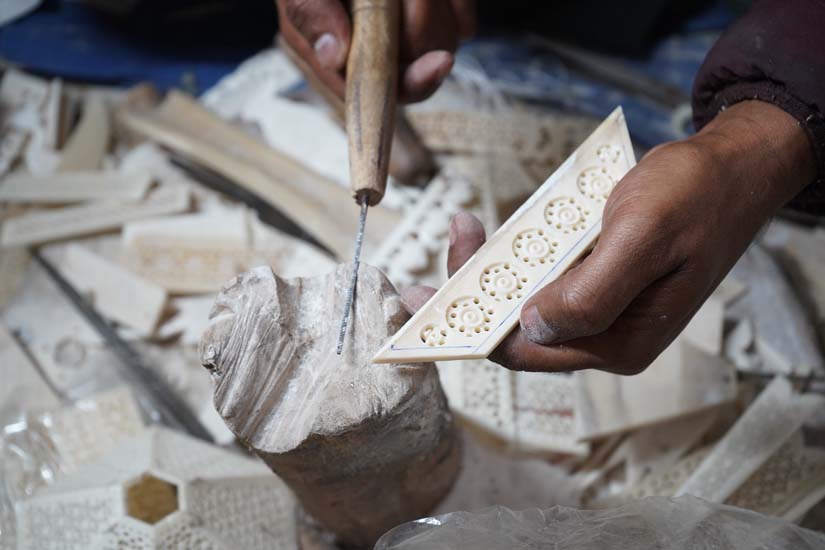
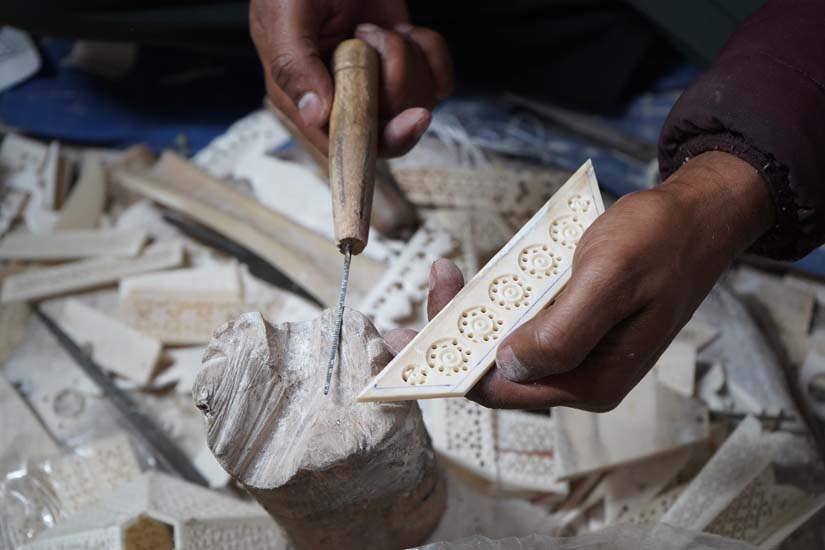
Tekora – A fine tool made from thin wire, used to file and refine the small holes in jaali work
Tipehal – Used for adding fine detailing to the carving
Reti (files) – Used for smoothing and shaping surfaces
Regmal (sandpaper) – Used for further smoothing and finishing
Chakki Patthar – A grinding stone base that provides stability while working
Thiya – A circular wooden base with a stand, used to hold and support the workpiece
Hydrogen peroxide – Used to clean and enhance the natural appearance of the bone
Khari Soda– Used to remove the oily surface and whiten the bone
Buffing soap – Used in the final stage to polish and give shine to the finished product
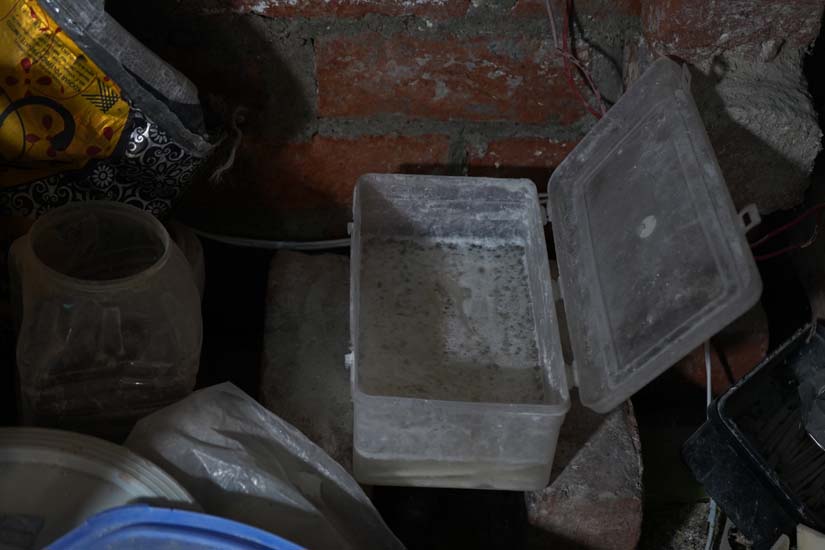
Bones have been associated with tantra-mantra practices, in which they are considered auspicious and believed to offer protection from buri nazar (evil eye). Historically, bone ornaments such as necklaces and other jewellery were worn by tribal communities, carrying both cultural and symbolic significance.
Bone carving is an intricate craft and can take anywhere from a few hours to several months, depending on the product’s complexity. Typically, a single piece may be made by an individual artisan from start to finish, or at times, 5 to 6 artisans work collaboratively, each specialising in a different stage.
The process begins with bringing buffalo bones from the slaughterhouse. These bones are first cleaned and prepared. Using Basuli (a hammer-like tool), the outer layer of the bone is carefully peeled off. This step is crucial, as the outer surface is yellowish and contains impurities. Once removed, it reveals the smooth, white inner surface suitable for carving.
The bones are then cut into smaller pieces using an Aari (handsaw) or the motor machine. After cutting, they are washed with khari soda (used to wash clothes) to remove oil, fat, grease, and organic matter. This process prevents decomposition, reduces odor and also whitens the bone.
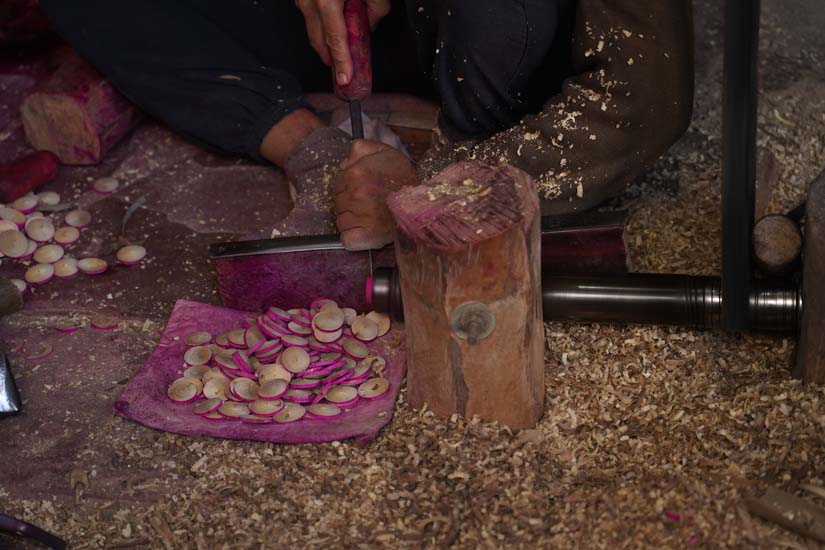
Once cleaned, the bone pieces are dried and then sanded on motor machines fitted with circular plates to achieve a smooth and flat surface.
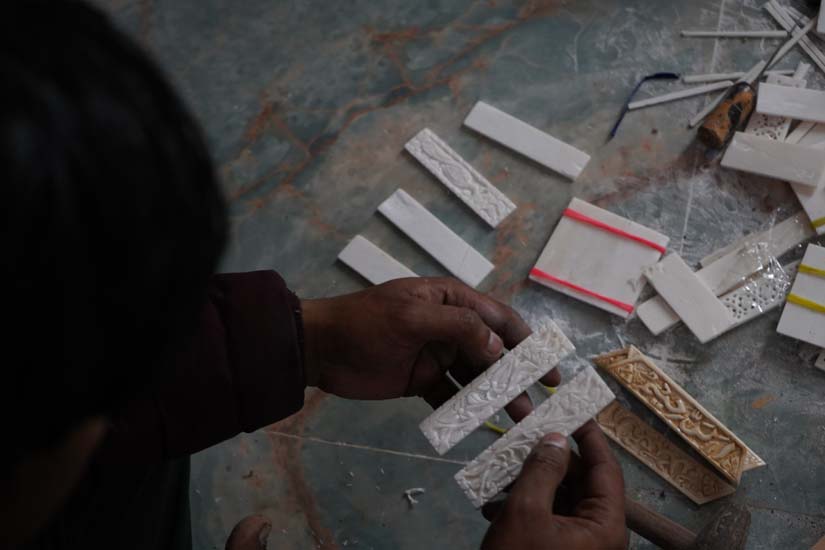
The creative process begins with marking the surface. Artisans draw patterns and refine them using a prakar (compass tool) to ensure symmetry and accuracy. The carving is then carried out using tools such as chisels (Teherka/Chausi), files (Reti), and drills. Small holes are created using a drilling machine or a hand drill with fine needles. Notably, intricate jaali (lattice) work is done entirely by hand, as machines cannot achieve the same level of delicacy and control.
There are two main types of naqqashi prominent in Lucknow-
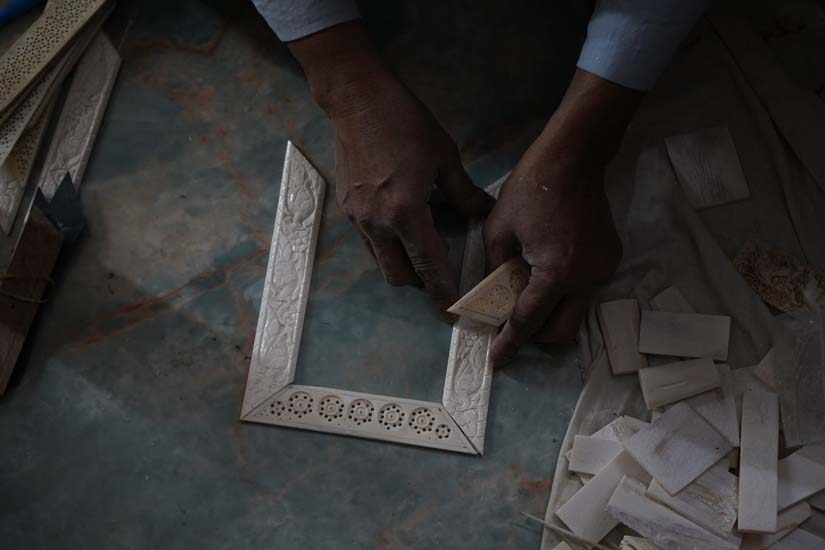
Jaali work – intricate pierced lattice patterns, which are the most popular and characteristic of Lucknow. Often, multiple jaali components (around 5–6 pieces) are created separately and later assembled to form a single product, such as a lamp.
Carving – creating surface-level, two-dimensional designs like animals, birds, trees, flowers,
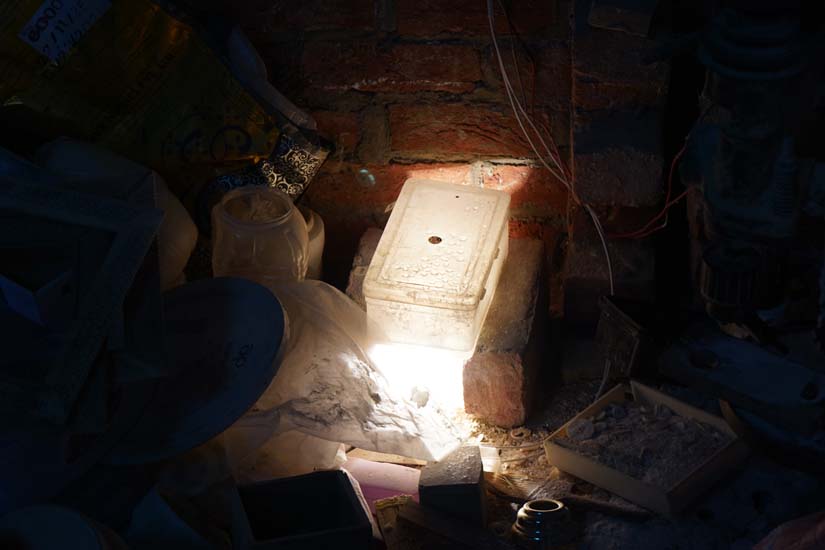
Following this, the carved bone pieces are treated with hydrogen peroxide. By soaking them for 8–10 hours in Hydrogen peroxide, in a closed box in direct sunlight (or a bulb is placed under the box) to assist in the whitening process. This step cleans the material further and gives it a uniform, bright appearance.
The final stage is polishing and finishing. The product is buffed on a motor machine using buffing soap (polish batti), which enhances the shine and brings out the intricate details.
In many cases, especially for larger items, small pieces of carved bone are joined together using adhesives like Fevicol. These may be assembled onto a wooden base (for example, in lamps or vases) and left to dry for about a day. Some products are further sent for painting to Jaipur, where various visual narratives are painted onto them.
For giving certain products a brown, vintage appearance, artisans may use dyes or natural techniques such as boiling the product with tea leaves. This step is optional and depends on the design.
Over time, bone naturally develops a warm yellowish-brown shade, adding character and value to the craft.
Despite the availability of mechanised tools such as laser cutting, artisans largely avoid it as the intense heat generated by lasers can burn, discolour, and weaken the bone, compromising both its durability and aesthetic quality. Therefore, traditional and semi-mechanised techniques remain preferred, as they offer greater control and preserve the integrity of the material.
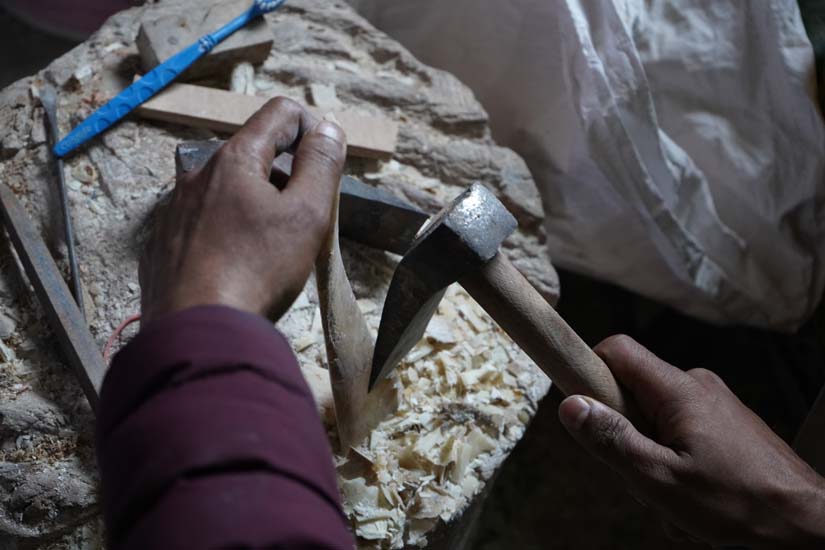
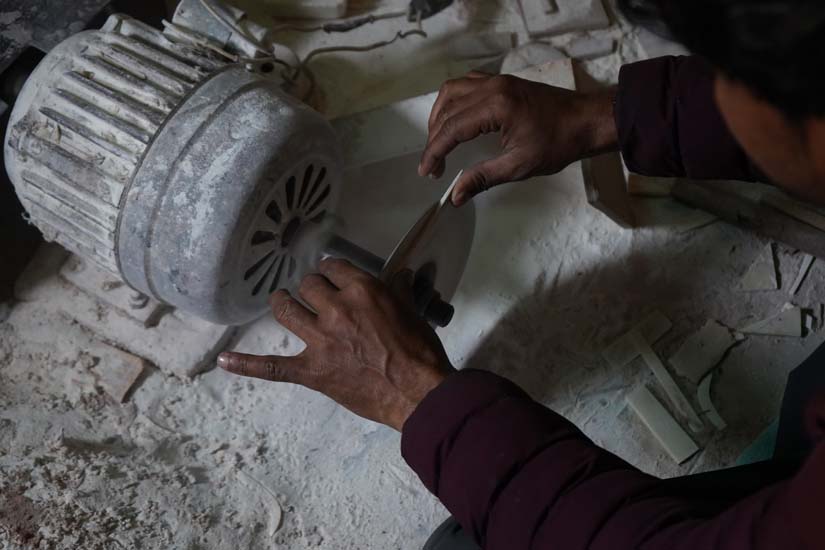
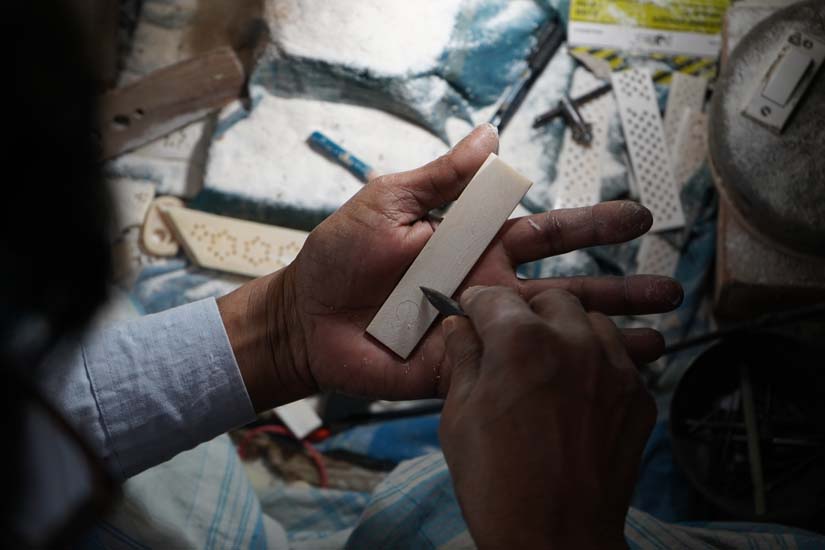
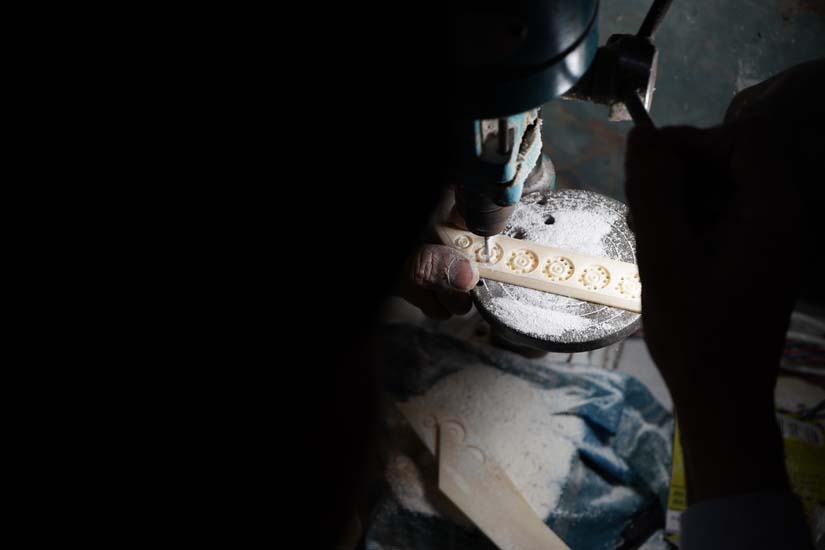
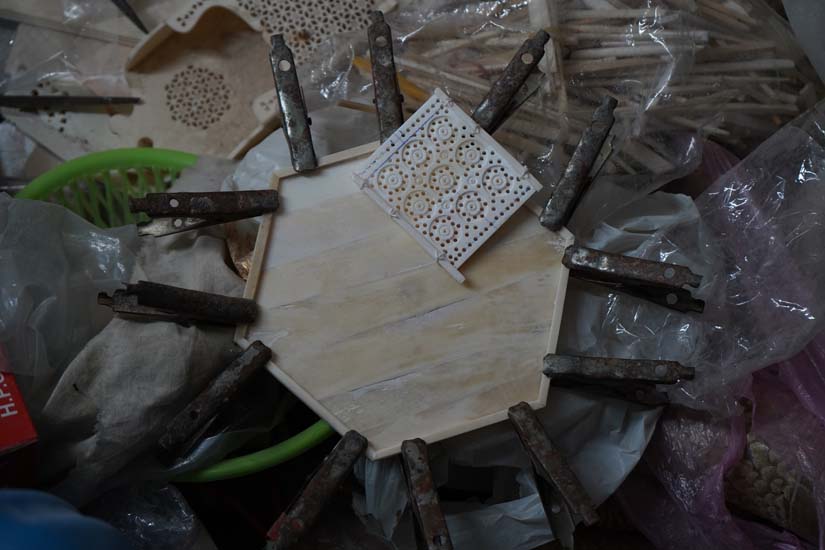
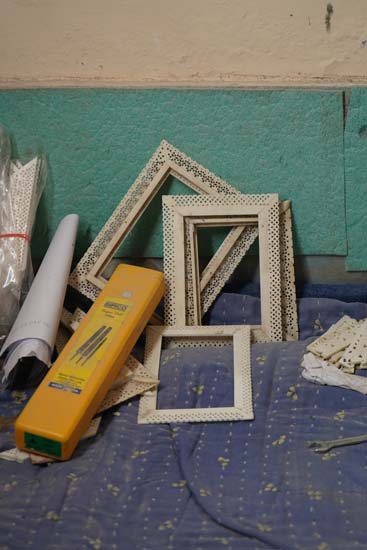
The waste that is generated is the bone powder or certain leftover bone pieces. These leftovers are used for various purposes and do not go to waste. The crushed bone powder is utilised and sold for various purposes, including use in medicines, fertilisers, and as feed for certain animals. Sometimes these leftovers are further recycled and used as manure in agriculture.
The history of Lucknow, is a rich and layered narrative that traces back to ancient times. It is believed to have been a part of the Kosala Mahajanapada, ruled by the Suryavanshi (Ikshvaku) dynasty. This
ancient history intertwines with the legendary tales of the Ramayana. According to popular tradition, after the conquest of Sri Lanka, Ramchandra gifted this territory to his devoted brother, Lakshmana, leading to the city's original name being referred to as Lakshmanpur or Lachmanpur, which later evolved into its present name, Lucknow. While legends suggest that the entire population of Ayodhya departed following Rama’s ascent to heaven, leaving Lakshmanpur as a suburban outpost, the region remains a significant link to the historical sites of Ayodhya and Shravasti.
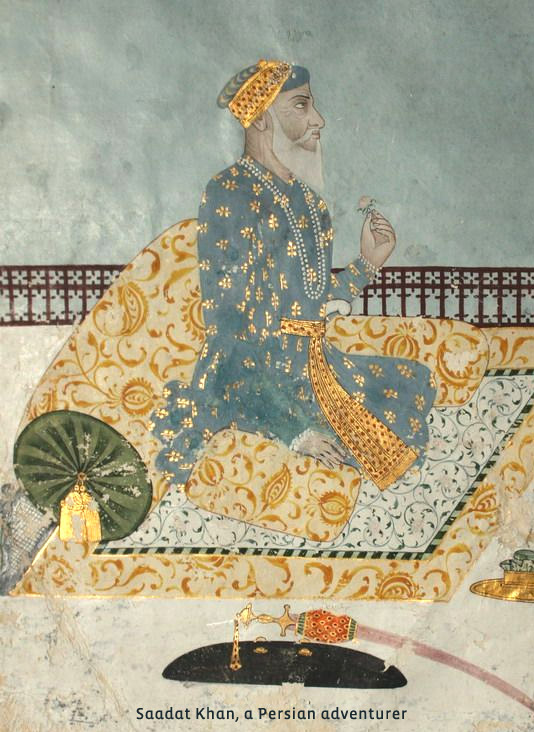
From the 14th century onward, Lucknow came under successive rulers, including the Delhi Sultanate, the Mughals, the Nawabs of Awadh, and later the British. However, its true prominence grew during the Mughal period, especially after Emperor Akbar established the province of Oudh (Awadh) in 1580. The archives of Akbar’s reign mark a definitive shift in the city's status. Its modern history begins in 1732 when the Persian adventurer named Mohammed Amin, better known as Saadat Khan, was appointed the Governor of Awadh. His descendants, who came to be known as the Nawab Wazirs, gradually asserted their independence from the declining Mughal authority, setting the stage for Lucknow to become a sovereign cultural capital.
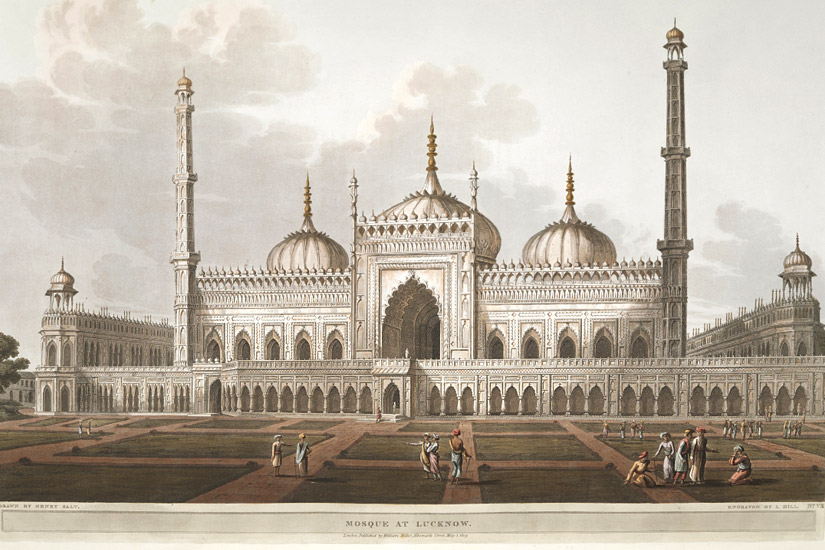
A defining moment in the city’s history occurred in 1775 when Nawab Asaf-ud-Daulah relocated the capital from Faizabad to Lucknow. This move ushered in an era of unprecedented architectural splendor and cultural refinement. Under the Nawabs, Lucknow flourished as a hub of art and literature, drawing artists and craftsmen from declining Mughal centers. This migration shaped the city’s unique identity of "Tehzeeb" (courtly etiquette) and artistic excellence. Magnificent structures like the Bara Imambara, the Rumi Darwaza, and the Chhota Imambara were constructed during this time, reflecting a sophisticated blend of Mughal, Persian, and emerging European influences.
However, this period of autonomy slowly eroded as the Nawabs became increasingly dependent on British support and succumbed to mounting political pressures. The mid-19th century brought a tumultuous turning point when the British East India Company, under Lord Dalhousie, annexed Awadh in 1856. This ended the Nawabi rule and led to the virtual imprisonment and exile of the last Nawab, Wajid Ali Shah, to Calcutta. The annexation sparked significant unrest, culminating in the Indian Rebellion of 1857. During this fight for freedom, Begum Hazrat Mahal, one of Wajid Ali Shah’s wives, played a prominent role in leading the resistance against British forces.Despite the resistance, Awadh was firmly incorporated into British India, signaling the end of an era and the beginning of a new chapter in the region's history. The legacy of Awadh, characterized by its rich cultural heritage and tumultuous past, continues to resonate in
modern-day India.
Today, Lucknow stands as a vibrant, cosmopolitan city that balances its historic heritage with modern development. Known for its architecture, cuisine, and manners (tehzeeb), it remains a significant cultural and urban centre where tradition and modernity coexist seamlessly.
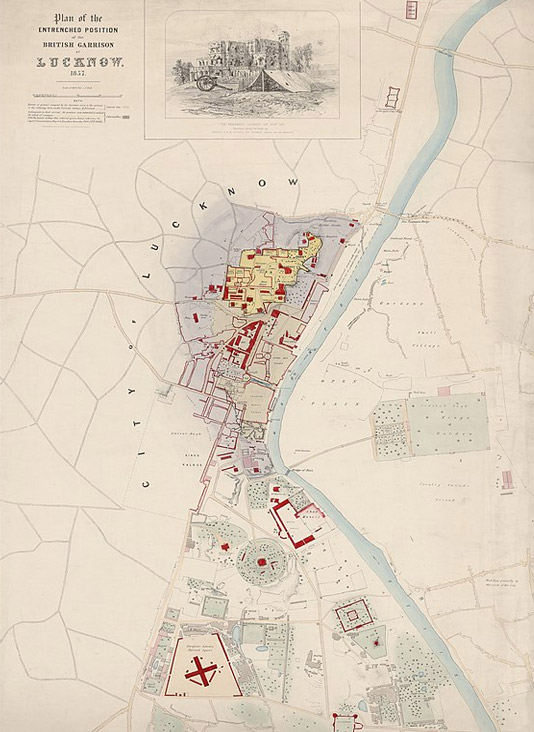
Lucknow, the capital of Uttar Pradesh, is located in the northern Gangetic plains of India at approximately 26.50° N latitude and 80.50° E longitude, with an average elevation of about 123 metres above sea level. The city lies along the Gomti River, its primary geographical feature, which flows through Lucknow.
Situated in the heart of the Indo-Gangetic Plain, Lucknow is surrounded by towns and districts such as Malihabad, Kakori, Mohanlalganj, Gosainganj, Chinhat, and Itaunja. It is bordered by Barabanki to the east, Unnao to the west, Raebareli to the south, and Sitapur and Hardoi to the north.
Morphologically, the city can be divided into three zones: the central business district (including Hazratganj, Aminabad, and Chowk), a middle residential zone, and an outer zone comprising newly incorporated villages.
Lucknow experiences a varied climate with extreme summers and winters, influenced by its geographical location. Its strategic position also makes it well-connected by air, rail, and road, contributing to its growth as a major urban centre.
Lucknow features a humid subtropical climate, characterised by hot summers, cool winters, and a distinct monsoon season. Being a landlocked city in the Indo-Gangetic plains, it experiences a continental climate with significant seasonal variations. The city experiences a continental weather pattern, which leads to significant variations in temperature and humidity throughout the year.
Summers in Lucknow are notably intense, typically lasting from March to mid-May. During this period, the weather is extremely hot and dry, with average maximum temperatures soaring into the high 30s. At the peak of summer, temperatures frequently range between 38°C and 45°C, occasionally
spiking to 46°C during severe heat waves. This dry heat creates a challenging environment before the arrival of the seasonal rains.
The monsoon season provides a critical transition, occurring between June and October. This period accounts for more than nine-tenths of the city’s annual precipitation, with roughly 75% to 90% of the rain falling specifically between June and September due to the southwest monsoon winds. While the average annual rainfall is approximately 827.2 mm (about 32.57 inches), it can vary between 800 mm and 1000 mm. This season is marked by a significant increase in humidity and persistent cloud cover.
As the rains recede, the city moves into a cool and dry winter, which extends from mid-November through February. During these months, temperatures range from a pleasant maximum of 25°C to chilly minimums between 3°C and 7°C. A defining feature of Lucknow's winter is the dense fog that
commonly blankets the city from mid-December to late January. Occasionally, the city may also receive light frontal rainfall in January, driven by the northeast monsoon. Overall, Lucknow’s climate is defined by these extreme temperature ranges and a heavy reliance on the monsoon cycle.
Lucknow stands as a pivotal infrastructure and economic powerhouse in Northern India. As a major transportation hub, the city is seamlessly linked to the rest of the country via an extensive network of national highways, including NH-30, NH-27, and NH-24. This road network is further strengthened by expressways like the Agra–Lucknow Expressway and the Purvanchal Expressway, which have drastically reduced travel times to Delhi and eastern Uttar Pradesh. Complementing these roads is a
robust railway system centred at the Charbagh Railway Station. Renowned for its stunning Indo- Saracenic architecture, Charbagh is one of the busiest stations in North India, connecting the city to every major Indian metro, while suburban stations like Bakshi Ka Talab and Kakori cater to local
commuting needs.
The city’s internal and international reach is further expanded through advanced air facilities. The Chaudhary Charan Singh International Airport in Amausi serves as a vital gateway, offering domestic flights to major cities like Mumbai and Bengaluru, as well as international routes to Dubai, Muscat, and Bangkok. Within the city, the Lucknow Metro, inaugurated in 2017, has revolutionized urban travel by providing a fast, efficient link between key locations like Munshipulia and the airport. This is supported by an integrated public transport system comprising CNG low-floor buses operated by LCTSL, auto-rickshaws, and modern app-based commute services, ensuring smooth mobility for its growing population.
Beyond its role as a transit hub, Lucknow has evolved into a diversified centre for industry, defence, and education. It is an emerging destination for IT, software, and automobile sectors, while also serving as the strategic Headquarters of the Central Command of the Indian Army. The city’s intellectual landscape is equally prestigious, housing elite institutions such as IIM Lucknow, IIIT Lucknow, and the Central Drug Research Institute (CDRI). This blend of modern industrial growth and academic excellence is anchored by a deep-rooted cultural identity. Recently designated as a City of Gastronomy by UNESCO, Overall, Lucknow's well-developed infrastructure plays a vital role in facilitating mobility, commerce, and connectivity, contributing to the city's growth and development.
Lucknow, the seat of the Nawabs of Awadh, is renowned for its rich architectural heritage, showcasing a distinctive blend of Indo-Islamic, Mughal, Persian, and European styles, often termed as Awadhi-European or Indo-Saracenic.
The Nawabi era was marked by an architectural "Golden Age" where traditional aesthetics merged with emerging Western influences. The city’s identity is defined by its use of lakhauri bricks, lime plaster, and delicate stucco work. Religious structures such as imambaras and mosques stand alongside secular wonders like baradaris (pavilions), enclosed baghs (gardens), and taikhanas (underground chambers). A unique symbolic motif found throughout the city is the fish, an auspicious
emblem used on gateways and royal buildings.
Among the city’s most iconic landmarks is the Bara Imambara, built in 1784 by Nawab Asaf-ud-Daula. It is a structural marvel, featuring Asia's largest vaulted hall constructed without any external pillars or beams. Nearby stands the Rumi Darwaza, a 60-foot-tall gateway inspired by the Sublime Porte in Istanbul, which serves as a grand entrance to the old city. The Chhota Imambara, with its intricate calligraphy and chandeliers, further exemplifies the "Nawabi fusion" of Mughlai and Turkish styles.
As the British influence grew, the architectural landscape expanded to include English Baroque and Neo-Classical styles. The Dilkusha Kothi remains a prime example of English Baroque design, while La Martiniere College is a unique blend of Italian and Indian aesthetics. Later, the Indo- Saracenic Revival style became prominent in civic structures like the Charbagh Railway Station and the Uttar Pradesh Vidhan Sabha building, which combine European structural concepts with
Indian domes and arches.
Today, Lucknow’s architecture continues to evolve, seamlessly blending the old with the new. In the central hub of Hazratganj, Victorian-era lamp-posts and colonial-style facades stand alongside contemporary multi-level parking lots and modern offices. This coexistence shows the city’s historical grandeur and urban development.
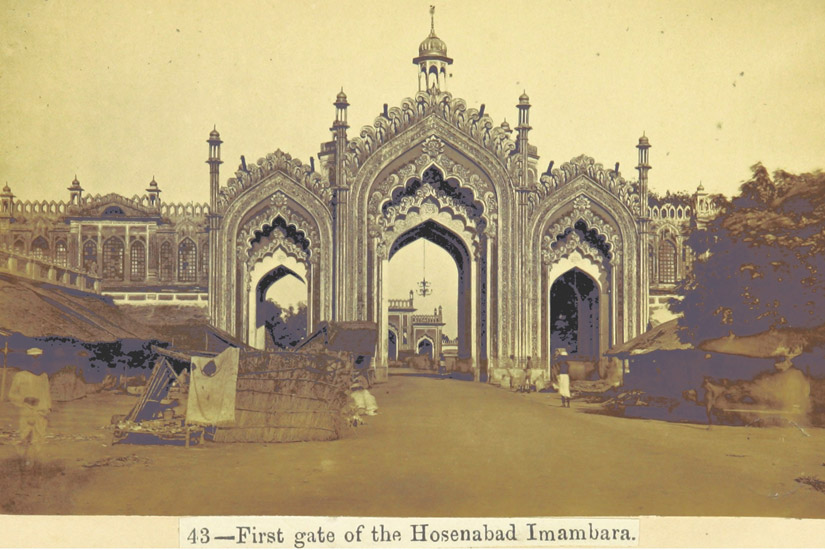
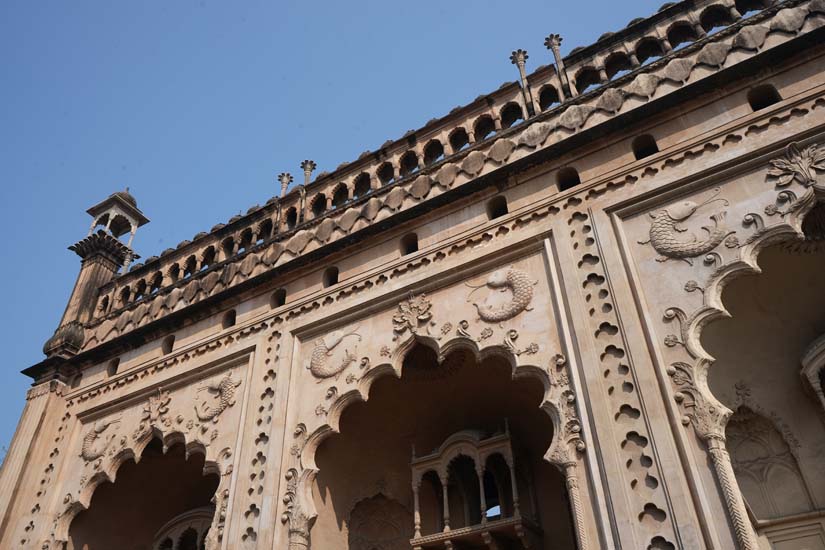
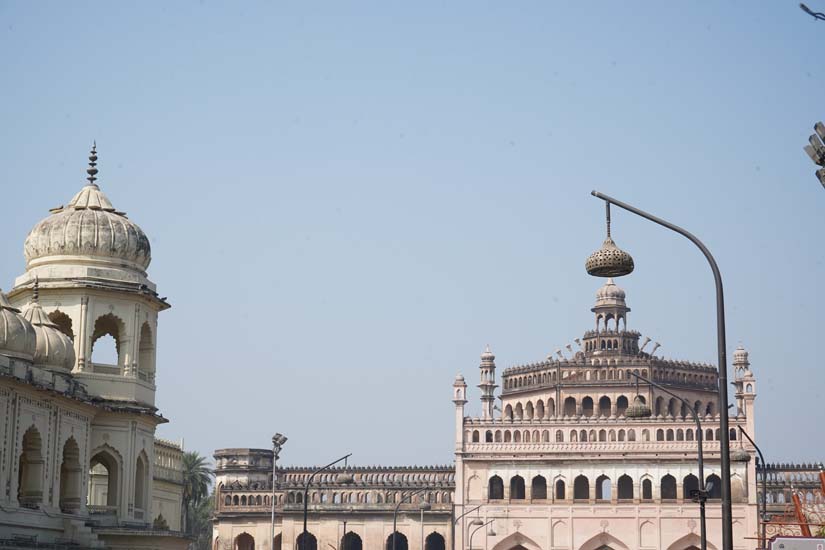
The city of lucknow is defined by Lucknowi Tehzeeb,a sophisticated composite culture rooted in harmony, elegance, and warmth. The city owes much of its cultural richness to the Nawabs of Awadh, who fostered secular and combined traditions. Central to this identity is the concept of Adab (refined courtesy) and Mehman-nawazi (hospitality), traits that remain deeply ingrained in the city’s native people. Even today, the polished manner of speaking, the distinct Lakhnavi boli,serves as a hallmark of its residents, who proudly identify as Lakhnavis.
Language plays a pivotal role in Lucknow's culture, with colloquial Hindustani being the most commonly spoken tongue, alongside Hindi and Indian English. The Urdu language, deeply ingrained in Lucknavi culture, is used in poetry, literature, and by affluent families, adding to the citys linguistic diversity. Additionally, Awadhi, a local dialect, continues to be spoken in Lucknow's rural areas and by its urban populace.
Prominent for its literature, the city has produced legendary poets like Mir Babar Ali Anis and Mirza Dabeer, masters of poetry. The city's influence extended to revolutionary figures like Ram Prasad
Bismil, who immortalized Lucknow in his poetry.
Additionally, the city’s culture is celebrated through oral traditions like Ghazals and Sher-o-shairi, and through the rhythmic elegance of Kathak dance, specifically the Lucknow Gharana, which was represented by masters like Pandit Birju Maharaj. The bustling lanes of Chowk and Aminabad remain the city's cultural heart. These historic bazaars
are the epicentre of Lucknow’s artistic heritage and the best places to witness its living traditions.
The city’s rich textile legacy is most evident here, particularly in the traditional Gharara an exquisite women's outfit featuring pleated trousers and intricate embroidery that originated in the Nawabi courts.
These markets also hum with the energy of traditional artisans and the spirit of unique local pastimes such as Patangbazi (kite flying), Kabutarbazi (pigeon racing), and Baterbazi (quail fighting). Overall, Lucknow&'s cultural tapestry is a testament to its inclusive ethos and enduring legacy as a cradle of art, literature, and tradition.
The people of Lucknow reflect a rich cultural diversity, with major religions including Hinduism and Islam, along with other communities living harmoniously. The city is known for its refined social culture, often referred to as Lucknowi Tehzeeb, which emphasises politeness, hospitality, and graceful conduct. Traditional attire for women includes sarees and salwar-kameez, often adorned with chikankari embroidery, while men traditionally wear kurta-pyjama or sherwani. Today, the urban population blends these traditions with contemporary fashion.
Lucknow has also been home to many prominent personalities across various fields. Notable figures include Birju Maharaj, a legendary exponent of the Lucknow gharana of Kathak, Javed Akhtar, known for his contribution to Hindi cinema and poetry, Anup Jalota, famous for devotional music, Naseeruddin Shah, a celebrated figure in Indian theatre and film, and Atal Bihari Vajpayee, a respected political leader. These individuals highlight Lucknow’s strong cultural, artistic, and intellectual legacy.
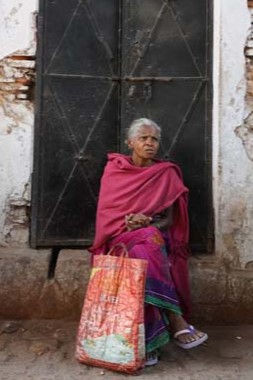
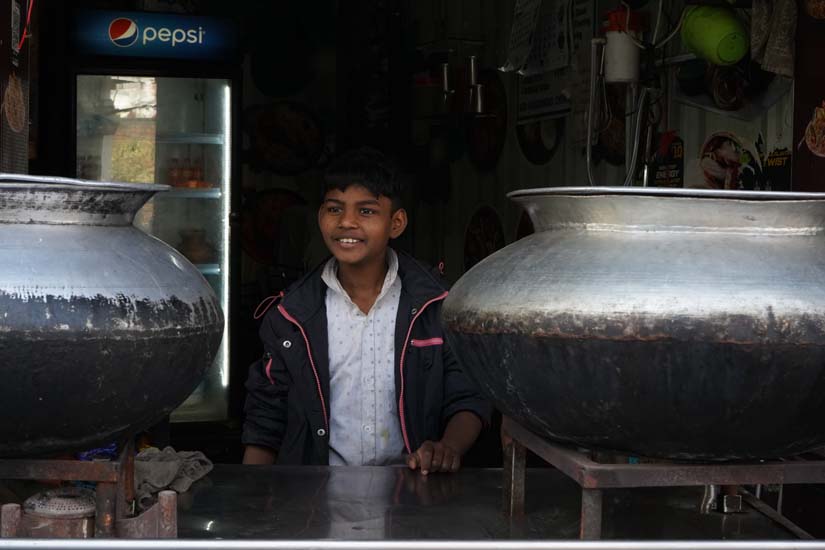
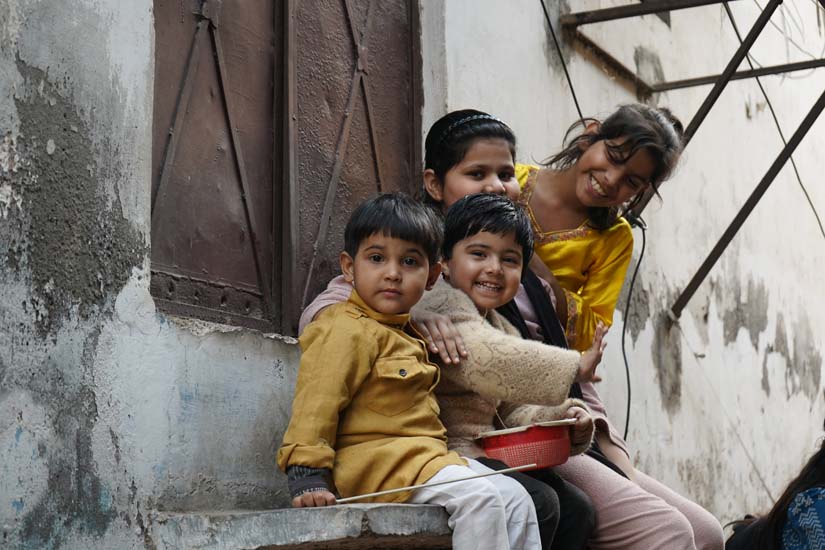
Lucknow is world-renowned for its "Ganga-Jamuni Tehzeeb," a unique syncretic culture defined by refined manners (Adab), warm hospitality (Mehman-nawazi), and a sophisticated lifestyle. This heritage is most vibrant in the historic Chowk area, a bustling hub for artisans and traders. The city’s cultural calendar reflects this inclusive spirit, featuring the solemn and grand Muharram processions alongside the festive Bada Mangal celebrations, where city-wide community meals (Bhandaras) showcase Lucknow's harmonious social fabric.
The city is a global leader in traditional craftsmanship, particularly its exquisite Chikankari and Lakhnawi Zardozi embroidery, which form the backbone of its local economy. Lucknow’s artistic contributions extend to the performing arts as the birthplace of the Lucknow Gharana of Kathak, championed by legends like Thakur Prasad and Pandit Birju Maharaj. Its musical legacy is equally prestigious, having nurtured icons like the "Queen of Ghazal" Begum Akhtar, legendary composer Naushad, and even pop star Sir Cliff Richard. Institutions like the Bhatkande Music Institute and Bhartendu Academy of Dramatic Arts continue to cultivate this rich creative lineage.
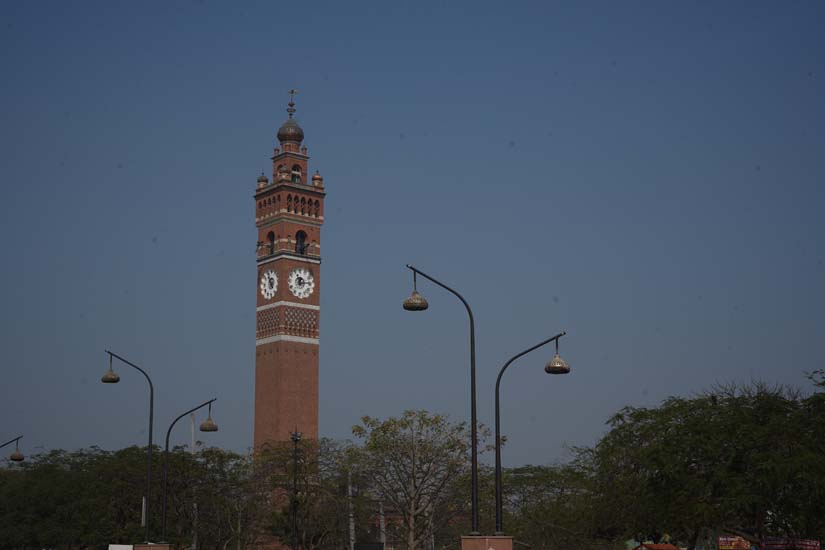
Architecturally, Lucknow is a treasure trove of Nawabi grandeur and colonial history. The Bara Imambara is a global engineering marvel, housing the world’s largest arched hall built without external supports, while the 60-foot Rumi Darwaza serves as an iconic ornamental gateway to the city. Other landmarks like the portrait-filled Chhota Imambara, the soaring Husainabad Clock Tower, and the historic British Residency, a silent witness to the 1857 Rebellion.
Beyond monuments and arts, the city is a paradise for food lovers and nature enthusiasts. It is the heart of Awadhi cuisine, famous for its melt-in-the-mouth kebabs, fragrant biryanis, and the world-renowned Dussehri mangoes. With its lush gardens, prominent educational institutions like LaMartiniere College, and living traditions like Patangbazi (kite flying), Lucknow remains an elegant city where historical attributes and modern vitality coexist seamlessly.
List of craftsmen.
https://aud.delhi.gov.in/sites/default/files/inline-files/dharohar_e-magazine_iii.pdf
https://www.researchgate.net/publication/395363759_BONE_CARVING_IN_LUCKNOWA_LIVING_TRADITION_OF_ART#:~:text=The%20decline%20of%20the%20Mughal,the%20architectural%20grandeur%20of%20Lucknow’
https://www.dsource.in/resource/bone-carving-lucknow/tools-and-raw-materials
https://gaatha.com/bones-carving-craft-uttar-pradesh/
